
Customer Svc: 855-620-2330 -
M-Sat -9am-6pm
Speak To Customer Service - 855-620-2330 - M-Sat 9:00am - 6:00pm MST
Customer Svc: 855-620-2330 -
M-Sat -9am-6pm
Speak To Customer Service - 855-620-2330 - M-Sat 9:00am - 6:00pm MST

Last Updated: October 9, 2026
Not every home has the space or commitment for a permanent golf simulator enclosure.
At Total Golf Simulators, we've helped homeowners work within their constraints, reclaiming a garage, dealing with 10-foot ceilings, or testing the simulator experience before committing to permanent construction.
You don't have to choose between a realistic simulator and a practical living space. Here's how to set up an indoor practice area that adapts to your room, budget, and lifestyle.
A retractable golf simulator screen solves the storage problem: instead of a permanent frame, it rolls up and disappears when you're done.
The Vanish Series Retractable Golf Enclosure represents the most advanced option in this category. It features patent-protected construction-grade materials that absorb high-velocity shots without degrading.

What makes retractable screens practical:
The Vanish Series comes in multiple sizes. If your ceiling exceeds 144 inches, 2-foot screen extensions are sold separately.
One consideration: motorized retraction needs a nearby power outlet.
A golf hitting net is the simplest path to indoor practice. Unlike enclosures requiring ceiling mounting or frame assembly, nets stand independently and pack flat.
The Net Return Pro uses a patented S-shape design that absorbs ball force and returns it gently back to you.
Why golfers choose net-based setups:
The trade-off: nets don't offer projection-based visual feedback, you rely on launch monitor data and feel rather than watching ball flight.
When you need a professional-grade enclosure without sacrificing your room's other uses, a foldable system bridges the gap.

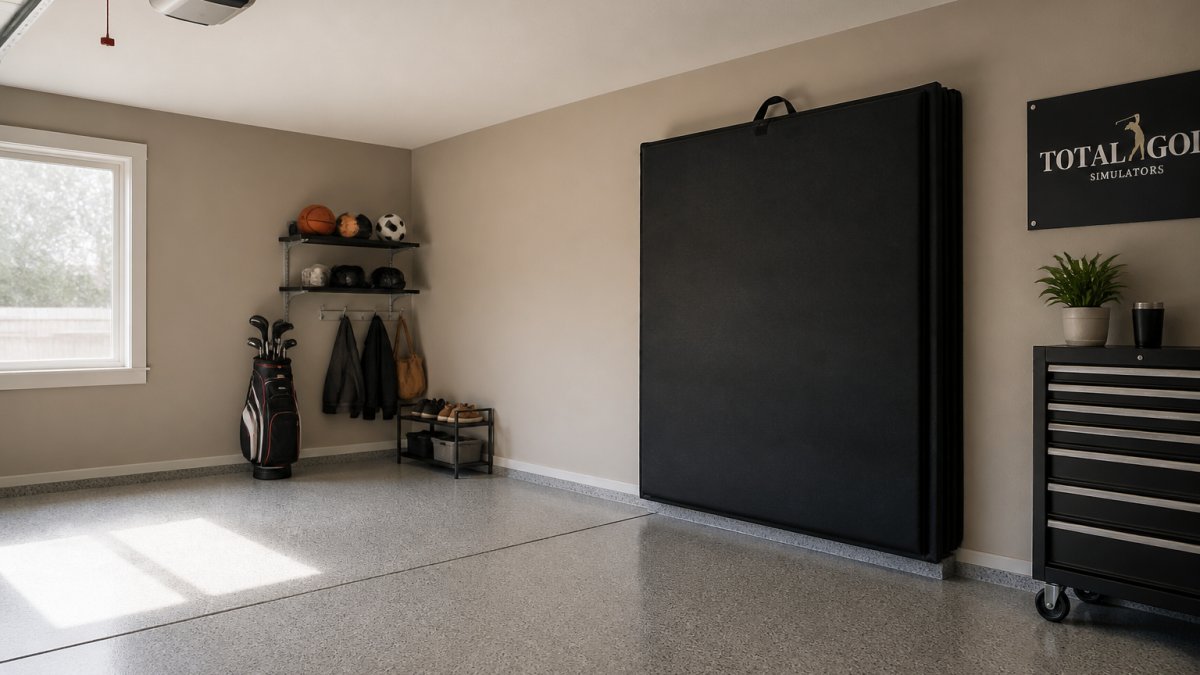
The Impact Sports Collapsible Enclosure folds flat against the wall when not in use.
It works with all major launch monitors and projector setups, with custom sizes for unusual dimensions.
Key advantages of portable enclosures:
Installation is straightforward with no permanent mounting, and you can move it between rooms as needs change.
A 10-foot ceiling doesn't eliminate your options, it changes which solutions work. Match the alternative to the room you actually have.
For a full driver swing, most golfers need roughly 9 to 10 feet of clearance from floor to the lowest obstruction, assuming a mid-handicap swing arc and a standard 45-inch driver. Taller players and steeper attack angles push that up.
Vanish Series® Retractable Golf Enclosure →
Measure from the floor to the lowest point in the swing zone, not the average ceiling height. A single duct, beam, or light fixture in the wrong spot can rule out a ceiling-mounted system even when the rest of the room measures fine.
Small rooms raise the stakes on containment, a mis-hit ball in a 10-foot-wide space has less distance to slow down before reaching a wall, window, or person.
If you have 10 feet of ceiling and a dedicated bay, a motorized drop-down or retractable screen gives the most simulator-like experience. With 8 feet of ceiling or a shared room, a net-based setup is the lowest-risk path. If you need the room back after every session, prioritize anything that folds flat or retracts, portability and storage footprint matter more than screen size in a tight space.
Price tags tell only part of the story. Two setups with the same sticker price can cost very different amounts over five years once you factor in mounting hardware, replacement screens, storage, and the value of the space you give up. The table below compares alternatives on the dimensions that drive the decision.
Solution |
Price |
Best For |
Space Requirement |
Setup Time |
|---|---|---|---|---|
Net Return Pro |
$795 |
Budget-conscious starters |
Any room, any ceiling |
15 minutes |
DIY Golf Enclosure |
$1,349 |
Customizable, semi-permanent |
Garage or basement |
2-4 hours |
Impact Sports Collapsible |
$1,999 |
Multi-use rooms |
10x8 ft minimum |
30 minutes |
Motorized Drop Down |
$2,650 |
Low-ceiling spaces |
10 ft ceiling minimum |
2-3 hours |
Vanish Series Retractable |
$2,999 |
Premium, space-saving |
9-16 ft width options |
1-2 hours |
The purchase price is just the entry ticket, ongoing costs separate a setup that fits your life from one you regret. Budget for:
Containment requirements scale with how much of the room the setup protects. A net contains the ball in one direction. A full enclosure contains it on all sides and overhead.
The DIY Golf Enclosure System ($1,349) deserves attention for flexibility: five sizes, multiple upgrade options, and a base kit with a high-quality impact projection screen, RipStop black wrapper, replaceable trim sleeves, and ball bungees.
Total Golf Simulators offers a Price Match Guarantee on all products. If you find a lower price elsewhere, we'll match it. Free shipping applies to most items, removing another cost variable.
The cheapest setup is rarely the one with the lowest sticker price. It's the one whose ongoing costs, storage needs, and space demands match how you actually use the room. Start with your ceiling height and your room's other jobs, then let the price table narrow the field.
Start with physical constraints: measure ceiling height, available width and depth, and obstacles like beams or pipes. These three measurements eliminate most options immediately.
Next, consider your use case: short game, full swings, or both? Launch monitor data, visual feedback, or both?
Finally, think about installation. Some systems require ceiling work and permanent mounting. Others set up in minutes with no tools.
The Impact Sports Collapsible Enclosure works best for homeowners with 10x8 foot spaces who need flexibility. It stores completely flat, requires no permanent installation, and works with any launch monitor or projector system.
Choosing an alternative to a permanent golf simulator enclosure doesn't mean compromising on practice quality. Total Golf Simulators offers five proven solutions, from the affordable Net Return Pro to the premium Vanish Series Retractable Enclosure, each designed for different spaces and budgets. Our team can help you match the right system to your room dimensions, ceiling height, and goals. Shop Golf Simulators today and turn your garage, basement, or spare room into a year-round golf practice facility that fits your life.

You have several practical alternatives: retractable golf simulator screens that roll up when not in use, portable foldable enclosures that collapse flat against the wall, golf simulator net setups for compact spaces, and motorized drop-down systems that lower only when you're practicing. Each option preserves your room's multi-purpose functionality while still containing ball flight and protecting your space. Your choice depends on your ceiling height, available space, and how often you practice.
Yes. Retractable golf simulator screens use construction-grade, patent-protected materials designed to withstand high-velocity shots. The Vanish Series retractable enclosure, for example, features a premium 3-ply impact screen with corner protection and reinforced side baffles to keep balls contained. They mount securely to ceilings between 108 and 144 inches high and require 8-12 inches of clearance behind the screen for safety. Rapid retraction lets you store the enclosure in seconds when not in use.
Yes, golf nets work with launch monitors. A golf simulator net setup like The Net Return Pro provides a spacious hitting area with automatic ball return via its patented S-shape design. It works indoors or outdoors, packs down quickly, and is ideal if you want more room than a standard net without overwhelming a garage or spare room. Pair it with a launch monitor like SkyTrak or Foresight for full simulator functionality in a compact footprint.
For a small space golf simulator setup, you need at minimum 8-10 feet of depth and 9-10 feet of width. Ceiling height matters: most setups work in ceilings as low as 8-9 feet, though 10 feet is more comfortable. Foldable enclosures like the Impact Sports model collapse flat when not in use, making them ideal for basements, garages, or bedrooms where space is shared. The DIY Golf Enclosure System comes in five sizes to fit various room dimensions.
Costs vary by option. A golf simulator net setup starts around $795 (The Net Return Pro). Foldable and portable enclosures range from $1,999 to $2,999 depending on size and features. Motorized drop-down systems run $2,650. These prices cover the enclosure only; you'll need to budget separately for a launch monitor, projector, hitting mat, and software. Unlike permanent installations, portable alternatives avoid renovation costs and let you recover some value if you later move or repurpose the space.