
Customer Svc: 855-620-2330 -
M-Sat -9am-6pm
Speak To Customer Service - 855-620-2330 - M-Sat 9:00am - 6:00pm MST
Customer Svc: 855-620-2330 -
M-Sat -9am-6pm
Speak To Customer Service - 855-620-2330 - M-Sat 9:00am - 6:00pm MST

Last Updated: September 29, 2026
A launch monitor captures precise ball and club data at impact, translating your swing into measurable metrics like ball speed, launch angle, spin rate, and carry distance. The best golf launch monitor for accuracy combines reliable tracking technology with real-time feedback. Why does accuracy matter? A 2-degree error in launch angle costs 10-15 yards off the tee; spin rate data off by 200 RPM changes club selection entirely. Total Golf Simulators offers a curated selection of industry-leading launch monitors to help you build the perfect indoor golf setup.
The two dominant technologies track ball and club data in fundamentally different ways, each with tradeoffs in accuracy, cost, and setup requirements.
Doppler radar systems emit radio waves to measure ball and club velocity and trajectory in real-time. Radar excels outdoors and indoors, unaffected by lighting. The downside: radar units are bulky, expensive, require significant clearance, and struggle with short-game accuracy because the signal can't differentiate fine club movements.
Photometric (camera-based) systems use high-speed imaging to track dimple patterns on the ball and markers on the club. They're compact, ceiling-mountable, and excel in confined spaces. The trade: they're sensitive to lighting and require consistent ball placement.
Hybrid systems combine both technologies for maximum precision. The FlightScope X3C pairs 3D Doppler Radar with high-speed image processing, capturing 50+ data parameters including environmental readings that refine ball-flight modeling.

For home simulators under 10 feet ceiling height, camera-based systems deliver tour-level accuracy without radar's space requirements. For outdoor range use or coaching, radar or hybrid systems justify the premium cost.
Golf Digest's launch monitor technology breakdown
Understanding what your launch monitor measures separates productive practice from shooting in the dark.
Ball speed is the velocity of the golf ball immediately after impact, measured in miles per hour. Faster ball speed means more distance, but only when paired with the right launch angle and spin rate.
Launch angle is the vertical angle at which the ball leaves the clubface. Too low and you lose distance; too high and the ball climbs without carrying far. Driver launch angles typically range 12-16 degrees.
Spin rate measures ball rotation in revolutions per minute (RPM). Backspin generates lift; sidespin causes curve. Drivers typically spin 2,000-2,500 RPM; irons 5,000-7,000 RPM. Too much spin on drivers costs distance; too little and the ball balloons.
Smash factor divides ball speed by club head speed, showing energy transfer efficiency. Driver smash factors range 1.45-1.50; irons 1.35-1.40. Low smash factor signals poor contact.
Carry distance is how far the ball travels through the air before landing. For simulators, carry distance determines where the ball lands on the virtual course.
Club head speed measures how fast the club is moving at impact. Combined with smash factor, it predicts ball speed and distance potential.
PGA Tour's official ball flight physics
TruGolf Apogee Indoor Launch Monitor →
Launch Monitor |
Technology |
Price |
Best For |
Key Advantage |
|---|---|---|---|---|
Garmin Approach R10 |
Photometric |
$599 |
Portable practice, beginners |
Most affordable, battery-powered |
Golf Joy Spica 3 |
Triple camera + AI |
$3,199 |
Indoor/outdoor flexibility |
27 data points, no special balls |
Uneekor Eye Mini |
Ball Optix dimple imaging |
$2,999 |
Home simulators, portability |
Compact, 19 metrics, standard balls |
TruGolf Launch Box |
Dual high-speed cameras |
$3,499 |
Indoor-focused facilities |
Instant feedback, 30 included courses |
NVisage N1 |
Overhead camera system |
$4,995 |
Budget overhead option |
Excellent price-to-accuracy ratio |
IDRA II |
Dual camera + stereoscopic |
$6,495 |
Short-game accuracy |
Tour-level putting and chipping data |
ProTee VX |
Dual camera + AI tracking |
$6,500 |
Commercial simulators |
Large hitting zone, marker-free club data |
Uneekor Eye XO |
Overhead infrared |
$7,999 |
Premium home simulators |
Overhead design, 20+ metrics, low latency |
Stereoscopic cameras |
$7,995 |
Professional studios |
Most accurate available, zero lag |
|
FlightScope X3C |
Doppler Radar + imaging |
$14,995 |
Tour coaching, research |
50+ metrics, environmental data |
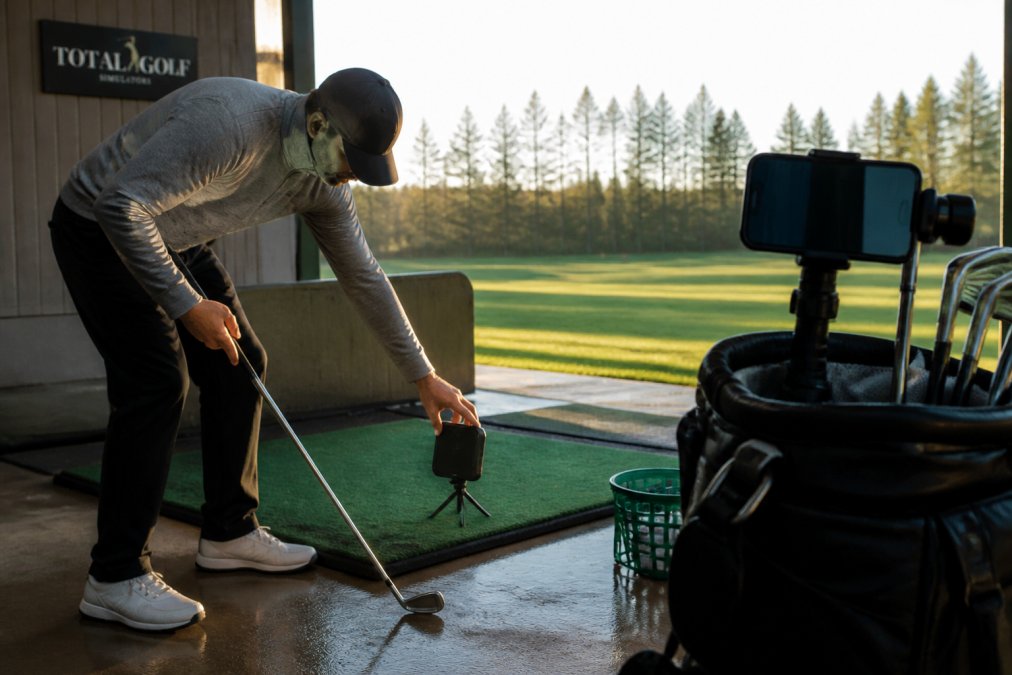
The Garmin Approach R10 ($599) is the most accessible launch monitor available. It's portable, battery-powered (10 hours per charge), and works indoors and outdoors. It tracks club head speed, ball speed, spin, launch angle, launch direction, and smash factor. The phone mount clips to your golf bag for between-shot viewing on the Garmin Golf app.
Best for: Golfers practicing at the range or in a backyard setting, beginners wanting to understand their swing numbers before committing to a full simulator.
These two deliver professional-grade data in a compact form factor without the overhead mounting complexity of larger systems.
The Uneekor Eye Mini ($2,999) uses Ball Optix dimple-based imaging to track any standard golf ball. It captures 19 data points with a built-in screen for instant feedback and fits in a carrying case for portability.
Overhead-mounted systems keep your hitting area clean and uncluttered. They're ideal for dedicated simulator rooms where the unit stays permanently installed.
These represent the top tier of launch monitor technology, the systems used by tour coaches, fitting centers, and elite training facilities.
Accuracy isn't absolute, it depends on your space, your setup, and what you're trying to measure.
Launch monitor accuracy degrades without proper maintenance. Clean camera lenses monthly with a soft microfiber cloth (never compressed air). Check firmware quarterly for tracking algorithm improvements. Inspect ceiling mounts every six months; loose mounts cause tracking inconsistency. Recalibrate per manufacturer guidance every three months. Temperature swings above 20°F and humidity above 80% affect accuracy; maintain climate control if possible.
Your simulator room environment directly affects measurement accuracy. Understanding these factors helps you optimize your setup.
Ambient light and sensor performance research
Yes, modern launch monitors deliver professional-grade accuracy when properly calibrated and maintained. Models like the TruGolf Apogee and FlightScope X3C use dual-camera systems and Doppler radar to capture real, measured data with zero lag. Accuracy depends on your launch monitor's technology, calibration frequency, and environmental conditions. Professional coaches and PGA facilities rely on high-end systems because the data is precise enough for swing analysis and club fitting.
Radar-based systems like the FlightScope X3C use Doppler radar combined with high-speed cameras to measure ball and club data with extreme precision, capturing over 50 metrics including environmental readings. Camera-based systems like the ProTee VX and Uneekor Eye XO use dual high-speed infrared or stereoscopic cameras with AI tracking, offering excellent accuracy in smaller spaces and lower power requirements. Radar excels outdoors and in large spaces; cameras excel indoors with tight ceiling heights and instant feedback.
Overhead-mounted systems are ideal for tight spaces. The Uneekor Eye XO, ProTee VX, and IDRA II all mount to the ceiling, requiring only 8-10 feet of height. These models deliver high accuracy without floor clutter and work well in basements or converted garages. The Garmin Approach R10 is also portable and works in compact spaces if you prefer a flexible, non-permanent setup.
The most important metrics are ball speed, launch angle, spin rate, carry distance, and club head speed. These five metrics reveal swing consistency and ball flight patterns. Smash factor (the ratio of ball speed to club head speed) shows strike quality. Side spin and spin axis show shot shape tendency. Apex height and descent angle help diagnose trajectory issues. Most launch monitors track 15-50+ metrics; focus on these core ones to avoid data overload and improve faster.
It depends on the model and software. The TruGolf Launch Box includes 30 courses and E6 CONNECT Home software with no annual subscription required. The Uneekor Eye Mini offers a free Player package but charges for Pro and Ultimate tiers to unlock advanced features like the AI Trainer. The Garmin Approach R10 includes a free 30-day trial of Garmin Golf membership. Many systems allow free third-party software integration (GSPro, E6 CONNECT) via separate licenses. Always check what's included versus what requires ongoing payment before purchasing.
Ready to build your ideal golf simulator setup? Total Golf Simulators specializes in matching launch monitors to your specific space and budget. Our team ensures your equipment integrates seamlessly, no guessing whether your launch monitor will work with your software or fit your ceiling height. Shop Golf Simulators and get started with a system that delivers the accuracy your game deserves.