
Customer Svc: 855-620-2330 -
M-Sat -9am-6pm
Speak To Customer Service - 855-620-2330 - M-Sat 9:00am - 6:00pm MST
Customer Svc: 855-620-2330 -
M-Sat -9am-6pm
Speak To Customer Service - 855-620-2330 - M-Sat 9:00am - 6:00pm MST

Last Updated: August 27, 2026
Picking the wrong launch monitor is an expensive mistake, with prices ranging from $599 to nearly $20,000. At Total Golf Simulators, we offer expert guidance to help you avoid common pitfalls. Buyers often purchase more than their space supports, less than their game requires, or miss subscription costs that inflate total outlay.
This guide covers the best launch monitors for 2026 across every price tier, from a sub-$600 radar unit to a $10,999 photometric system rivaling tour-level fitting bays. You'll find full specs, honest limitations, space requirements, and cost-of-ownership breakdowns most reviews skip.
Quick Picks:
Every monitor in this list was evaluated against four criteria that determine whether a build succeeds.

Uneekor Eye XO2 Launch Monitor & Optional Uneekor XO2 "All In" Pkg
A launch monitor is only as useful as the data it produces and the software it feeds. Critical metrics include ball speed, launch angle, carry distance, spin rate, back spin, side spin, smash factor, and club head speed. Some monitors gate advanced metrics behind subscription tiers, a real cost to factor in before purchase.
Software compatibility is equally critical. A monitor working seamlessly with GSPro, E6 Connect, and TGC 2019 offers flexibility. One locked into a proprietary platform puts you at the mercy of that platform's roadmap and pricing. According to NGF's overview of indoor golf growth, software ecosystems are now a primary purchase driver for serious buyers.
Hardware price is the starting point, not the finish line. Most buyers underestimate hidden costs:
Cost Category |
Low Estimate |
High Estimate |
Notes |
|---|---|---|---|
Hardware (launch monitor) |
$599 |
$10,999 |
One-time purchase |
Software subscription (annual) |
$0 |
$500+ |
Varies by platform and tier |
Replacement club stickers |
$20 |
$60/year |
Required for photometric club data |
Optional Pro Package upgrades |
$0 |
$300+ |
E.g., FlightScope Mevo+ Pro Package |
PC / iPad requirements |
$0 |
$1,500+ |
If hardware upgrade needed |
A lower-cost monitor can become more expensive over three years than a premium unit with no mandatory subscription. The Red Stakes Golf RSG One includes lifetime software access. The Uneekor Eye XO2 includes a 3-month trial; after that, paid subscriptions apply.

For dedicated indoor simulator bays, photometric camera systems generally outperform radar. For outdoor or dual-use setups, radar is competitive and more affordable.
Radar-based launch monitors use Doppler technology to track ball flight after impact. The FlightScope Mevo+ combines 3D Doppler radar with Fusion Tracking Technology, adding an internal camera to improve spin accuracy. Radar units need 7-10 feet of ball flight for reliable data and are lightweight, portable, and typically more affordable.
Photometric (camera-based) systems capture ball and club at impact using high-speed cameras. Units like the Uneekor Eye XO2 and TruGolf Apogee use stereoscopic or multi-camera arrays to measure spin, launch angle, club path, face angle, and apex height directly from image data, requiring no ball flight. This makes them far more reliable in short-room setups. As noted in Golf Digest's equipment technology coverage, photometric systems are the standard for professional fitting environments.

These are the best launch monitors available in 2026, ranked by use case and value.
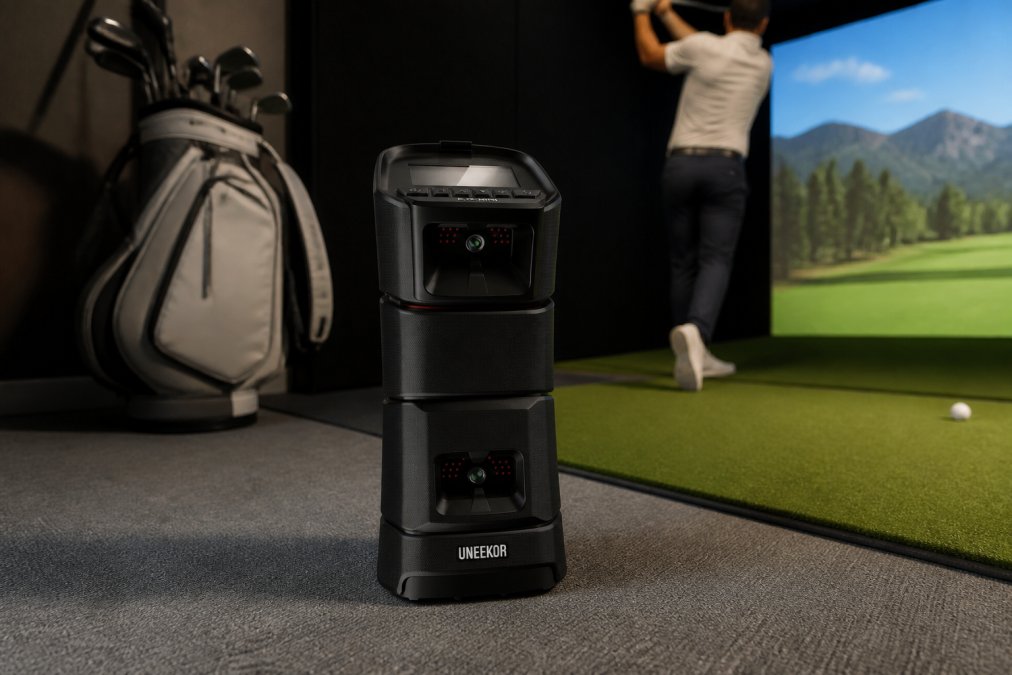
View of a premium indoor golf simulator bay with an on-ground launch monitor, impact screen, hitting mat, and ambient lighting in a finished basement with dark painted walls and recessed ceiling lights
Three high-speed infrared and photometric cameras deliver 24 data points covering ball and club metrics, including club path, face angle, dynamic loft, lie angle, and smash factor. The hitting zone is 28 inches wide by 21 inches long, and it works with any standard golf ball without marked balls. Overhead mounting keeps the floor clear with a recommended ceiling height of 9-10 feet. It integrates with Uneekor VIEW software, GSPro, E6 Connect, and TGC 2019. The package includes two Uneekor Swing Cameras and a 3-month trial of the Ultimate Package. Club data requires reflective stickers on the clubface. After the trial period, continued access to GameDay mode, AI Trainer, and advanced analytics requires a paid subscription.
Best for: Dedicated home simulator rooms, golf instruction studios, and commercial bays needing tour-level data without marked balls.
The Apogee's INSTANT IMPACT image analysis algorithm eliminates perceptible delay between swing and ball flight in the simulator. It uses ultra-high-speed stereoscopic cameras and measures ball speed, back spin, side spin, vertical launch angle, horizontal launch direction, club head speed, club face angle, and club path. It ships with E6 Connect Practice software and includes all mounting hardware and a laser level. TruGolf's return policy is strict: all sales are final unless approved in writing, with a 20% restocking fee once shipped.
The IDRA II is built specifically for short game, using dual high-speed cameras and AI-powered stereoscopic vision to capture accurate data across full swings, chips, and putts without marked balls or clubs. The overhead design keeps the hitting area clear and is commercially rated for teaching studios and golf facilities. GolfIn backs it with a 2-year manufacturer's warranty on camera components.
The NEO-E's ground-mounted 3-camera optical system delivers reliable ball and club data without ceiling installation, making it genuinely flexible for spaces that can't support overhead mounting. No marked balls are required. It integrates with GSPro and E6 Connect. The ground-mounted design allows easier repositioning for left- and right-handed golfers without hardware adjustments.
The Eye Mini delivers Uneekor photometric experience in a portable form factor using Ball Optix dimple-based imaging and Club Optix to capture clubhead speed, path, and angle of attack, delivering 19 data points without paywalling key metrics. The hitting zone is approximately 8 by 11 inches, so consistent ball placement is essential. It connects via Bluetooth, Wi-Fi, USB, or Ethernet and works with Uneekor VIEW on PC and VIEW Air on iPad. A built-in screen provides quick feedback without external devices. It carries a 1-year manufacturer warranty, and subscription upgrades unlock AI Trainer, GameDay mode, and third-party simulator connectivity.
Three ultra-high-speed cameras with an AI processing chip deliver feedback latency under 0.3 seconds. It tracks 27 data parameters covering club path, ball speed, launch angle, spin rate, side spin, apex height, carry distance, and more. The built-in LCD touchscreen eliminates the need for a phone or tablet between shots. A 9-axis gyroscope stabilizes the unit on uneven surfaces for outdoor use, with battery life of 6-7 hours per charge. It supports any golf ball and works with E6 Connect and GSPro. Recommended minimum ceiling height for indoor use is 9.2 feet.
The Mevo+ is the best radar-based launch monitor for golfers wanting one device that works at home, in the garage, and on the driving range. Its 3D Doppler radar combined with Fusion Tracking Technology delivers 20+ ball and club metrics, including ball speed, club head speed, spin rate, spin axis, carry distance, and smash factor. Indoor space requirements are modest: 7-9 feet from the unit to the ball, with 8-10 feet of ball flight recommended for best accuracy. It connects via Wi-Fi Direct with no internet required for measurements. Battery life is up to 3 hours. The optional Pro Package upgrade adds club path, attack angle, face-to-path, dynamic loft, swing plane, and additional metrics. Software compatibility covers E6 Connect, GSPro, TGC 2019, and Awesome Golf.
The RSG One is designed and manufactured in the United States and includes lifetime access to RSG CLUB software with 10 real-world courses and 3 practice ranges. Optional online multiplayer mode adds 35+ courses for $199/year. It uses high-speed camera and infrared sensors to capture club speed, ball speed, launch direction, launch angle, back spin, side spin, carry distance, and total distance. The unit sits 6 feet directly behind the golfer, keeping it safely away from shanks. It supports both right- and left-handed players without repositioning. Red Stakes backs it with a 365-day satisfaction guarantee and a 1-year technology warranty.
The Garmin Approach R10 at $599 is the best budget launch monitor under $1,000. It tracks club head speed, ball speed, spin, launch angle, launch direction, and smash factor using radar technology. It's genuinely portable, weighs almost nothing, and runs up to 10 hours on a single charge. It connects to the Garmin Golf app and supports virtual rounds on 42,000+ courses with an active subscription. E6 Connect compatibility is also available separately. For casual home practice and swing consistency work, the R10 delivers real value.
Space requirements are the most underestimated factor in any build. The minimum viable space is typically 10 feet wide, 10 feet deep, and 8.5 feet tall. Comfortable full-swing practice requires 12 feet wide, 15-16 feet deep, and 9 feet of ceiling clearance.
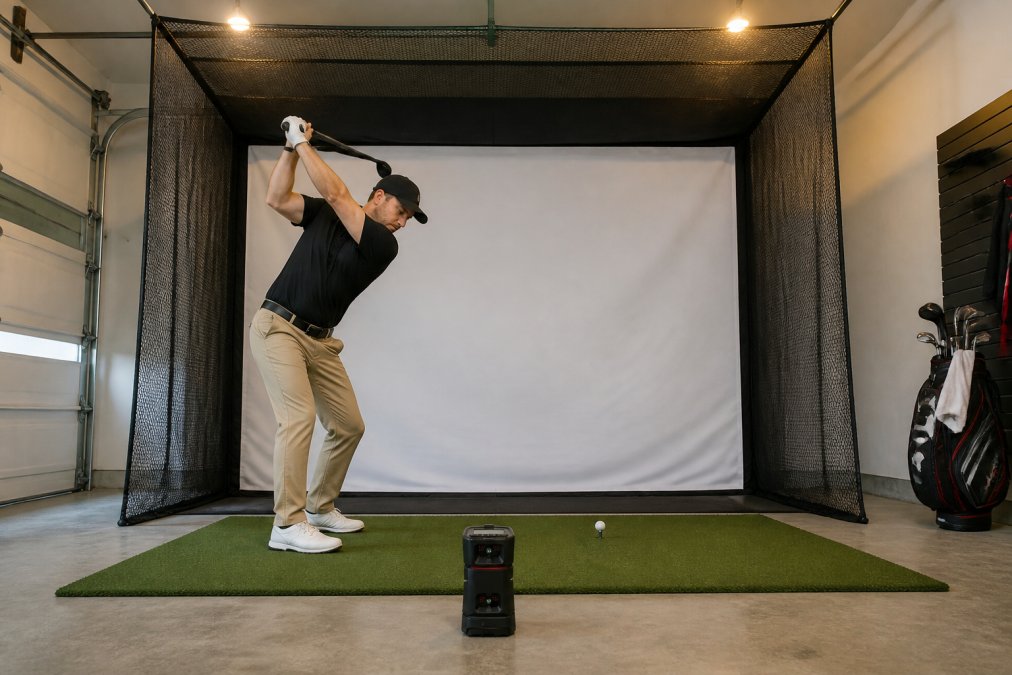
Ceiling height determines which monitors are viable for your space:
Monitor |
Mounting Type |
Min. Ceiling Height |
Min. Room Depth |
Ball Marking |
|---|---|---|---|---|
Uneekor Eye XO2 |
Overhead |
9-10 ft |
12 ft |
Not required |
TruGolf Apogee |
Overhead |
9-10 ft |
12 ft |
Not required |
Overhead |
9-10 ft |
12 ft |
Not required |
|
Uneekor Eye Mini |
Portable - Ground |
8.5 ft |
10 ft |
Not required |
Nvisage NEO-E |
Portable - Ground |
8.5 ft |
10 ft |
Not required |
Golf Joy Spica 3 |
Portable - Ground |
8.5 ft |
10 ft |
Not required |
FlightScope Mevo+ |
Portable - Ground |
8.5 ft |
14 ft |
Not required |
Red Stakes RSG One |
Ground (behind golfer) |
8.5 ft |
14 ft |
Uses TP5 Pix balls |
Garmin R10 |
Portable - Ground |
8.5 ft |
8-10 ft |
Not required |
A 10-foot ceiling is the comfortable floor for overhead-mounted photometric systems. If your basement ceiling is exactly 9 feet, overhead mounting is technically possible but leaves minimal margin for swing arc clearance. Ground-mounted and portable units are practical for ceilings under 9 feet.
Setup problems are more common than manufacturers admit, and most are solvable with the right checklist.
Overhead photometric monitors (Eye XO2, Apogee, IDRA II): Calibration failure is most common. Ensure the calibration template is flat, centered, and properly lit. Avoid direct sunlight or flickering fluorescent lights. Ethernet connectivity issues often stem from firewall settings. Chrome or highly reflective wedges can cause misreads; matte-finish clubs or included stickers resolve most cases.
Radar monitors (Mevo+, Garmin R10): If your room is shorter than 8 feet of ball flight space, the Mevo+ will produce inconsistent spin data. If your device shows a connected signal but data isn't transferring, toggle airplane mode to force a fresh Wi-Fi Direct handshake.
Ground-mounted units (NEO-E, Eye Mini, RSG One, Spica 3): Ball placement consistency matters more with ground-mounted units. Use alignment aids or tee position markers for repeatable placement. The RSG One must be placed exactly 6 feet behind the golfer; placement errors degrade accuracy significantly.
The right choice depends on your space, use case, and honest budget including software costs.
For dedicated home simulator rooms with 9+ foot ceilings: The Uneekor Eye XO2 at $10,999 is the best overall pick. If lag-free simulation is your priority, the TruGolf Apogee at $7,500 is the alternative.
For short game and instruction: The IDRA II at $6,495 is the only monitor purpose-built for putting and chipping analytics.
For tight spaces or flexible setups: The Nvisage NEO-E at $5,500 or the Golf Joy Spica 3 at $3,199 are practical choices without ceiling installation.
For dual indoor/outdoor use on a mid-range budget: The FlightScope Mevo+ at $2,339 is the clear winner.
For the best value with no ongoing software cost: The Red Stakes Golf RSG One at $1,999 with lifetime RSG CLUB access.
For casual practice and simulation under $1,000: The Garmin Approach R10 at $599 is the only credible option.
The best launch monitors for home simulators balance accuracy, software compatibility, and total cost. The Uneekor Eye XO2 at $10,999 leads for serious setups, offering 24 data points, a large hitting zone, and compatibility with GSPro, E6 Connect, and TGC 2019. If budget is the priority, the FlightScope Mevo+ at $2,339 delivers radar-based ball and club data with solid indoor performance. For those under $2,000, the RSG One includes lifetime software with 10 real-world courses.
Camera-based (photometric) launch monitors generally outperform radar indoors. Radar units need several feet of ball flight to calculate spin and carry distance accurately, which can limit precision in tight spaces. Photometric systems like the Uneekor Eye XO2 and TruGolf Apogee capture data at the moment of impact using high-speed cameras, delivering more reliable spin rate, launch angle, and side spin readings regardless of room depth. For dedicated simulator bays, photometric is the preferred technology.
Most overhead-mounted launch monitors require a ceiling height of 9 to 10 feet for proper installation and full swing clearance. The Uneekor Eye XO2 recommends a ceiling height of around 9 to 10 feet. Ground-mounted units like the FlightScope Mevo+ and Nvisage NEO-E are more forgiving and can work in spaces as low as 8.5 feet, though 9 feet or more is recommended for comfort. Always measure your room before purchasing to confirm compatibility with your chosen monitor type.
Spending depends on your goals. Casual players who want virtual golf and basic shot tracking can start with the Garmin Approach R10 at $599. Golfers focused on game improvement with reliable indoor data should look at the $2,000 to $5,000 range, where options like the RSG One, FlightScope Mevo+, and Golf Joy Spica 3 sit. Instruction studios and serious home sim users who need professional-grade accuracy and club data should budget $6,000 to $11,000 for units like the IDRA II or Uneekor Eye XO2.
Several launch monitors include base software at no extra cost, but advanced features often require subscriptions. The RSG One includes lifetime access to RSG CLUB software, while multiplayer mode costs $199 per year. Uneekor's Eye XO2 and Eye Mini come with a free Player package; upgrading to Pro or Ultimate for AI coaching and GameDay mode requires a paid subscription. The Garmin Approach R10 needs an active Garmin Golf app subscription for virtual rounds. Factor these recurring costs into your total cost of ownership before deciding.
This article was written using GrandRanker