
Customer Svc: 855-620-2330 -
M-Sat -9am-6pm
Speak To Customer Service - 855-620-2330 - M-Sat 9:00am - 6:00pm MST
Customer Svc: 855-620-2330 -
M-Sat -9am-6pm
Speak To Customer Service - 855-620-2330 - M-Sat 9:00am - 6:00pm MST

Last Updated: September 2, 2026
When winter hits or your schedule doesn't align with daylight hours, indoor golf alternatives become essential. The market has fragmented into different categories, each solving a different problem. Some focus purely on swing mechanics, others replicate full course play, and a few split the difference without excelling at either.
At Total Golf Simulators, we've spent years helping golfers navigate this landscape. The question isn't whether you need an indoor golf alternative, it's which type matches your space, budget, and practice goals. A net-based system won't teach you spin rates. A full simulator in a 10-foot ceiling becomes a frustrating compromise. Understanding these tradeoffs upfront saves thousands in buyer's remorse.
Golfers shop indoor golf alternatives for three core reasons: space constraints, budget limitations, or practice goals that don't require full course simulation. Some want to work on short game in a spare room. Others need something that packs away when guests arrive. A few are building commercial setups and need equipment that survives heavy use.
A complete golf simulator package combines three core components: a launch monitor that captures ball data, an impact screen that displays the virtual course, and an enclosure that contains the space. Real-time feedback includes club head speed, spin rate, shot dispersion, and carry distance. The software subscription provides access to virtual golf courses and practice ranges.

Full simulator systems demand serious space and budget. You need a minimum 10-foot width, ideally 12 feet or more for comfortable swing mechanics (pga.com). Ceiling height should be at least nine feet. Total investment typically runs between $3,000 and $15,000 depending on launch monitor and enclosure choice (peer-reviewed research).
The advantage is accuracy. Photometric sensors or radar-based tracking systems capture actual shot physics. You see real-time feedback that translates directly to course performance. Multiplayer mode lets you compete with friends, and software libraries include hundreds of courses. For serious golfers committed to year-round practice with measurable improvement, this is the only option that delivers.
Total Golf Simulators offers full-system packages built around industry-leading components. The DIY Golf Enclosure System w/Multiple Upgrade Options starts at $1,349 and gives you flexibility to add upgrades as your setup evolves, whether that's pole kits, foam wedge inserts, or protective caging.

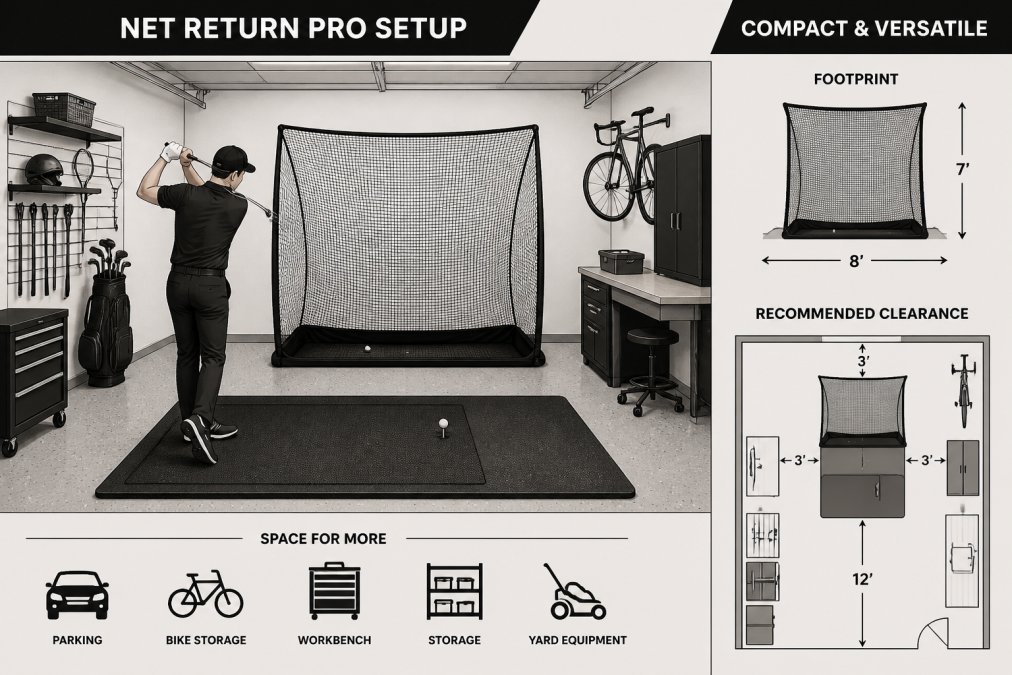
A golf net with automatic ball return offers a fundamentally different experience. You swing, the ball flies into the net, and a patented mechanism returns it to you. No launch monitor, virtual courses, or software subscription. What you get is a compact, affordable way to work on swing mechanics and rhythm.
Net systems excel in tight spaces. The Net Return Pro requires just eight feet of space and works indoors or outdoors. At $795, it's a fraction of what a full simulator costs. Setup takes minutes and teardown takes seconds. If your spare room doubles as a guest bedroom or your garage hosts other activities, a net system packs away when you need the space back.
The tradeoff is feedback. You don't get ball data and must rely on feel and visual observation to diagnose swing issues. For golfers with established swing mechanics who want to maintain rhythm during off-season, this works. For golfers trying to fix something or learn proper fundamentals, the lack of data becomes limiting.
The choice between building your own setup and buying a complete package shapes both your budget and timeline. DIY means sourcing individual components and handling assembly yourself. Turnkey means one supplier delivers everything pre-configured and handles installation.
| Approach | Initial Cost | Setup Time | Customization | Support |
|---|---|---|---|---|
| DIY Build | $2,500-$8,000 | 20-40 hours | High flexibility | Troubleshooting falls on you |
| Turnkey Package | $4,000-$12,000 | 2-4 hours | Limited options | Vendor handles issues |
| Net-Only System | $800-$1,200 | 30 minutes | Minimal | Simple product |
DIY appeals to budget-conscious builders. You avoid markup and choose each component individually. However, "compatible" doesn't always mean "optimal." A projector with 15-foot throw distance doesn't work in a 12-foot space. A launch monitor calibrated for outdoor use drifts indoors. These problems emerge after purchase, when returns become expensive.
Turnkey setups cost more upfront because the vendor has solved integration problems. Total Golf Simulators handles that complexity for you. When you buy an enclosure from us, it's designed to work with specific launch monitors and projectors. We've tested the combinations and know the ceiling height requirements. If something doesn't work after installation, you have one point of contact instead of calling three different manufacturers.
For most golfers, turnkey saves money in the long run despite the higher sticker price, when you factor in research time, mistakes, and compatibility issues.
A 10-by-8-foot basement or spare room is the reality for most homeowners. Standard enclosures don't fit these spaces. You need something designed for tight quarters without sacrificing the hitting experience.
The Golf Bays EasySim DIY Golf Simulator Enclosure at $999 solves this directly. At 10'9" wide by 8'2" high with just 3'3" depth, it's an affordable enclosure option optimized for compact spaces. The 4:3 aspect ratio simplifies projector selection. The Lite impact screen minimizes noise on impact, critical in shared living spaces. Assembly is straightforward, and the aluminum frame feels solid without being overengineered.
The depth limitation is real. You're swinging in a confined area, which changes your mechanics slightly compared to outdoor golf. But for winter practice, swing maintenance, and short game work, the tradeoff is acceptable. The screen durability holds up to repeated ball strikes, and replacement components are available.
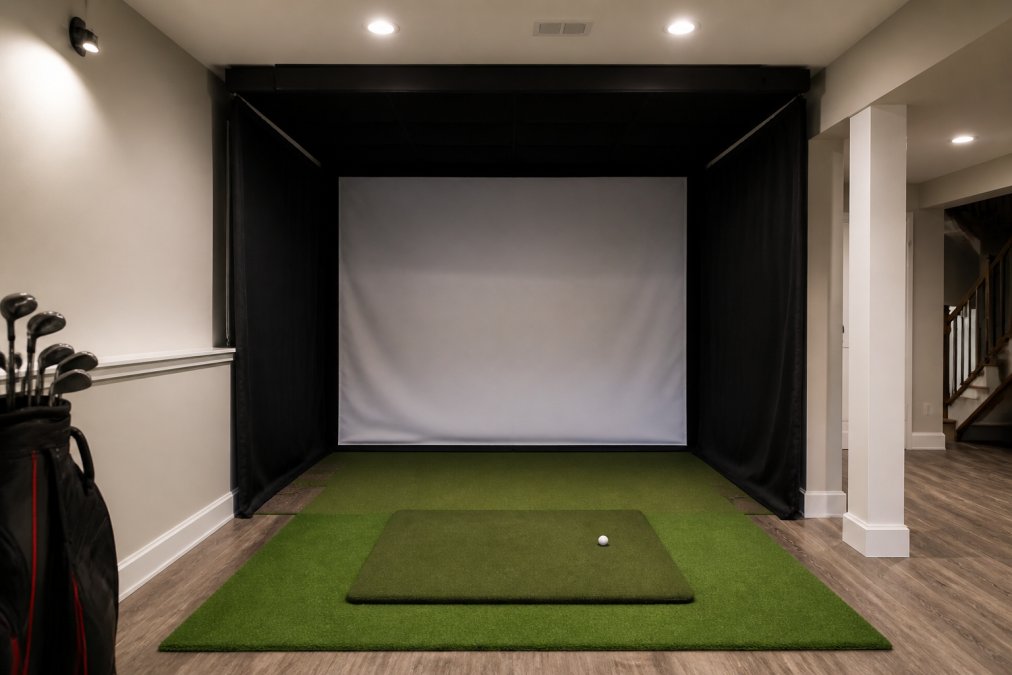
The Vanish Series Retractable Golf Enclosure at $2,999 is engineered for golfers who refuse to sacrifice living space. The enclosure rolls up and out of the way in seconds, transforming your room from a professional golf bay back to a normal living area.
The Vanish Series uses construction-grade materials rated for high-velocity shots. The premium impact screen and blackout backing eliminate light distortion. Multiple size options accommodate anything from a 9-foot room to a full 16-foot commercial space. The 2-year warranty covers defects in materials and workmanship. Installation requires proper mounting and ideally some electrical work for motorized retraction, but the result is a simulator that disappears when you're done practicing.
This option appeals to affluent homeowners and hospitality managers who need premium functionality without dedicated space.
Installing a golf simulator is more complex than assembling furniture. The launch monitor needs proper calibration. The projector requires precise throw distance and angle calculations. The enclosure frame must be level and structurally sound. The hitting mat needs to sit flush with the ground to prevent tripping hazards.

Many golfers attempt DIY installation and discover that proper installation matters more than expected. A launch monitor off by even a few inches gives inaccurate ball data (peer-reviewed research). A projector mounted at the wrong angle creates keystoning that distorts the virtual course. An enclosure frame that's not perfectly level causes screen sagging and uneven impact absorption.
Total Golf Simulators provides step-by-step installation guides for every product, and our team is available to troubleshoot issues. We've worked with commercial facilities, luxury resorts, and residential customers. Our Price Match Guarantee and free shipping on most items mean you're not paying extra for convenience.
The launch monitor is the brain of your simulator. It captures ball data and feeds it to the software. The impact screen is the display surface where you see the virtual course. These two components determine your simulator's accuracy and visual experience more than anything else.
Launch monitors fall into two categories: photometric sensors and radar-based systems. Photometric systems use high-speed cameras to track ball flight in the first few feet after impact. They're accurate for spin rate and launch angle but require consistent lighting. Radar-based systems use Doppler radar to track the ball through its entire flight and are more tolerant of different lighting conditions.
For home simulators, most golfers choose systems that balance accuracy with price. The market has matured enough that mid-range launch monitors deliver data quality rivaling expensive commercial systems. What matters is consistency, does the monitor give you the same reading when you hit the same shot twice?
Impact screens vary by material and construction. Budget screens use single-layer fabric that absorbs impact but can show wear after heavy use. Premium screens use multi-ply construction with reinforced edges and corner protection. The projector throw distance determines which screen size works in your space.
Budget setups prioritize affordability and space efficiency. You're looking at net systems, compact enclosures, and entry-level launch monitors. Total investment stays under $2,000. The tradeoff is accuracy and course variety.
Premium setups invest in components that deliver professional-grade accuracy and immersive experience. High-end launch monitors capture nine different metrics per shot. Premium enclosures use construction-grade materials and professional-grade screens. Total investment runs $8,000 to $15,000 or more.
The real question isn't budget versus premium, it's what you actually need to accomplish your goal. A golfer working on swing fundamentals with an instructor needs accurate ball data. A golfer maintaining rhythm during winter needs a net system. A golfer who wants to play virtual rounds for entertainment needs full course simulation.
Total Golf Simulators helps you match setup to actual need through our Simulator Finder Quiz. Rather than pushing the most expensive package, we ask questions about your space, budget, and practice goals. The Impact Sports DIY Golf Simulator Enclosure at $1,342 represents the sweet spot for many buyers. You get a full enclosure system with poles, padding, and high-density impact screen included. The modular design lets you add upgrades later.
Choosing an indoor golf alternative means understanding your actual constraints and what you want to practice. A net system won't replace a full simulator, but it's perfect if you have limited space and want to maintain swing tempo. A compact enclosure solves the ceiling height problem without forcing you into a massive footprint. A premium retractable enclosure lets you have both a golf simulator and a living room.
Total Golf Simulators has helped thousands of golfers build setups that work for their homes and their games. Start with our Simulator Finder Quiz to match your space and budget to the right equipment, then shop our curated selection of industry-leading components. Free shipping on most items and our Price Match Guarantee mean you're getting genuine value.
A: The Net Return Pro ($795) offers an affordable entry point for year-round practice. It provides instant ball return without requiring launch monitor data or software subscriptions. For budget-conscious golfers who want basic feedback, nets eliminate the complexity and cost of simulators while still delivering consistent practice. If you need swing data, the Golf Bays EasySim enclosure ($999) is an affordable full setup option available.
A: DIY golf simulators require you to source and assemble components separately, typically costing $2,000-$5,000 depending on launch monitor and software choices. Turnkey packages bundle everything, enclosure, screen, hitting mat, and software, reducing assembly time and compatibility risk. Total Golf Simulators offers pre-configured packages starting at $999, eliminating guesswork. Turnkey solutions cost more upfront but save troubleshooting time and ensure all components work together seamlessly.
A: The Vanish Series ($2,999) rolls up and retracts in seconds, transforming your space from a golf bay back to a living area instantly. Standard enclosures like the Impact Sports ($1,342) or DIY Golf Bay ($1,349) are permanent installations. The Vanish is ideal if you need multi-purpose space and want to hide the simulator when not in use. The trade-off is higher cost and ceiling height requirements (108-144 inches).
A: Most enclosure systems are designed for DIY assembly and include step-by-step instructions. However, installation services are valuable if you're uncomfortable with electrical work (for projector power), ceiling mounting, or turf installation. Total Golf Simulators provides expert guidance to help you assess your space and select compatible components. Professional installation ensures proper alignment of launch monitors and projectors, which directly affects ball-flight accuracy and data reliability.
A: Yes, most alternatives work in 10-foot ceilings. The Golf Bays EasySim (10'9" wide × 8'2" high × 3'3" deep) and The Net Return Pro fit standard garage or basement spaces. The Vanish Series requires 108-144 inches of ceiling height, so a 10-foot (120-inch) ceiling is compatible. Always measure your space first and account for swing clearance above your head, you need at least 2 feet of buffer above the impact screen.
This article was written using GrandRanker