
Customer Svc: 855-620-2330 -
M-Sat -9am-6pm
Speak To Customer Service - 855-620-2330 - M-Sat 9:00am - 6:00pm MST
Customer Svc: 855-620-2330 -
M-Sat -9am-6pm
Speak To Customer Service - 855-620-2330 - M-Sat 9:00am - 6:00pm MST

Last Updated: September 4, 2026
Finding the best golf simulator for basement use isn't about picking the most expensive gear. It's about matching the equipment to the physical constraints of your space, particularly ceiling height and depth. Many homeowners assume a 10-foot ceiling is plenty, and for most golfers it is, but the real challenge is the enclosure, lighting, and sound control that turn a bare room into a functional practice space.
At Total Golf Simulators, we've helped customers convert unfinished basements into year-round golf studios, and the most common mistake is buying a launch monitor first and measuring the room second. A golf simulator for basement setups requires a minimum ceiling height of 8.5 feet for most golfers using a standard swing, though 9 feet is the safe benchmark for anyone over 5'10" or using a driver. This guide breaks down the enclosure options, launch monitor technologies, and projector specs that actually work in tight, low-ceiling spaces, with specific product recommendations you can order today.
Below, we'll cover ceiling height calculations, radar versus camera tracking, enclosure systems that fit shallow depths, and the basement-specific concerns like acoustics and airflow that most guides ignore.
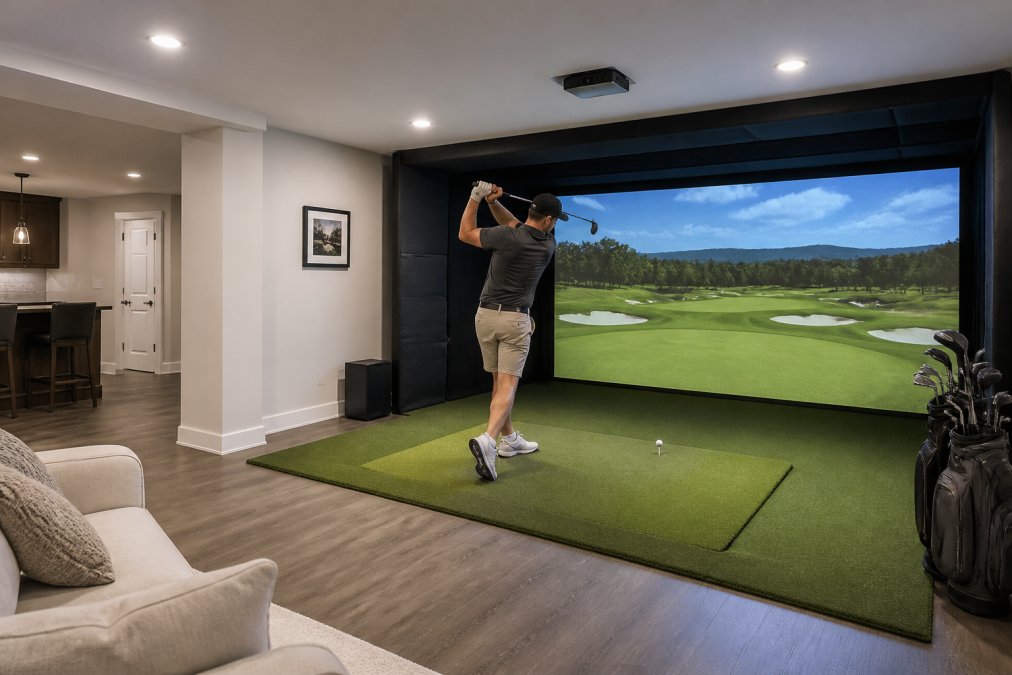
The minimum ceiling height for golf simulator installation is 8.5 feet for most players, but 9 feet is the recommended standard if you plan to hit driver. This isn't a suggestion; it's a physics problem. A standard driver swing arc requires roughly 8 feet of clearance from the floor to the top of your backswing, and that's before you account for the thickness of a hitting mat, which typically adds 1 to 2 inches, and the height of your shoes.
To calculate your exact requirement, stand in your hitting stance and extend a driver straight up along your swing plane. Measure from the floor to the clubhead. Add 6 inches of safety margin for the follow-through and any sway in your swing. If that number exceeds your ceiling height, you have two options: shorten your backswing, which is a bad habit to build, or choose a simulator setup that mounts the screen lower and uses a shorter tee height.
For spaces with ceilings between 8 and 9 feet, consider the USGA's guidelines on indoor swing mechanics which emphasize maintaining a natural swing plane. A collapsible enclosure like the Impact Sports Space Saving Collapsible Enclosure at $1,999 can be mounted to fit lower ceilings while still providing full protection, and its foldable design means you don't lose the room when you're not playing.

The best launch monitor for small spaces depends on your ceiling height and the distance you have from tee to screen. Radar-based systems like the Garmin Approach R10 at $599 use Doppler radar to track ball flight, and they require a clear line of sight and typically 8 to 10 feet of ball flight to generate accurate data. In a basement with less than 8 feet of depth, a radar unit will struggle to read spin and launch angle correctly because the ball hits the screen too quickly.
Camera-based systems are the better choice for tight spaces. The Uneekor Eye Mini Launch Monitor at $2,999 uses high-speed optical sensors and dimple-based imaging to track the ball at impact, which means it doesn't need ball flight to calculate carry distance, ball spin rate, or club head speed. It captures 19 data points including swing path, face angle, and smash factor, all from a hitting zone of roughly 8 inches by 11 inches. This makes it a strong choice for small spaces where radar simply cannot get a clean read.
| Launch Monitor | Technology | Price | Best For | Key Limitation |
|---|---|---|---|---|
| Garmin Approach R10 | Radar | $599 | Portability, outdoor range | Needs 8-10 ft of ball flight |
| Uneekor Eye Mini | Camera (optical) | $2,999 | Tight basements, data accuracy | Requires consistent ball placement |
If you're coming from a radar-based unit, expect the Eye Mini to feel different. Setup takes about 10 minutes, and you'll need to place the unit on a stable surface level with the ball. The data accuracy is worth the adjustment, particularly for indoor use where radar-based tracking can be unreliable below 8 feet of depth.
How to build home golf simulator setups in a basement comes down to one decision: how permanent do you want the installation to be? The enclosure is the largest physical structure in the room, and it determines whether your basement stays a multi-purpose space or becomes a dedicated golf studio.
For a permanent, high-end setup, the Carl's Place Pro Golf Simulator Enclosure (2025 Model) at $3,409.95 is a strong option. Its BlackStop fabric blocks ambient light, which sharpens the projector image, and the moveable crossbar lets you position the launch monitor perfectly without compromising the screen tension. It supports frame heights up to 135 inches, making it viable for basements with 9-foot ceilings or taller.
The Vanish Series Retractable Golf Enclosure at $2,999 is the world's first retractable golf enclosure. It mounts to ceilings between 108 and 144 inches, which covers 9 to 12 foot ceilings, and it includes a rear impact membrane, a 3-ply impact screen, side screens, and ceiling panels. The motorized roll-up design takes about 15 seconds to deploy or stow, and a manual hand-crank version is available if you don't have power near the mounting point.
For budget-conscious builders, the DIY Golf Enclosure System at $1,349 is a solid starting point. It's available in five sizes including 8x10 and 9x12 formats, and it uses 1-inch EMT conduit that you can source locally. The tradeoff is assembly time; expect a full afternoon to build the frame and tension the screen.

Basements present a unique lighting challenge because they typically have low ambient light, which is good for projector image quality, but they also have no windows, which means you need a projector bright enough to overcome any overhead lighting you leave on. The industry standard for golf simulator projectors is a minimum of 3000 lumens for a 10-foot wide image (projectorcentral.com).
The Optoma Golf Simulator Short Throw Projector ZW350ST at $939 delivers 3600 lumens with WXGA resolution, which is bright enough for most basement conditions. Its short throw ratio means you can place it closer to the screen, typically 4 to 6 feet away depending on your screen size, which is critical in a shallow room. It uses DuraCore laser technology rated for 30,000 hours of maintenance-free operation, so you won't be replacing lamps.
Screen selection matters as much as the projector. A 4:3 aspect ratio screen like the Golf Bays EasySim Enclosure at $999 is optimized for standard projector setups and gives you a taller image for a given width, which suits the vertical nature of ball flight. A 16:9 screen is wider and better for virtual golf courses that display more horizontal scenery, but it requires a wider room.

:::tip When choosing between a white and gray impact screen, gray screens like the high-contrast option on the Carl's Place Pro Enclosure reduce glare and improve contrast in rooms with any ambient light. White screens are brighter but wash out faster if you have overhead lights on during play. ::: basement layout design.
Most basement simulator guides stop at equipment selection, but the three issues that actually ruin the experience are noise, safety, and air quality. A driver striking a ball at 100 mph generates a sharp crack that echoes off concrete walls and low ceilings, making the space unpleasant for extended practice sessions (the CDC).
Acoustic dampening starts with the enclosure itself. Look for models with high-density safety padding and a bungee tension system, like the Impact Sports Collapsible Enclosure, which absorbs impact and minimizes bounce-back. Adding acoustic foam panels to the ceiling directly above the hitting area and on the wall behind the screen can help reduce echo. Sub-floor padding under the hitting mat also helps; it absorbs the vibration of your swing and the impact of the ball, rather than transmitting it through the concrete slab to the rest of the house.
Safety in a low-clearance basement is about protecting both you and the space. If your ceiling is under 9 feet, install a ceiling net or SkyGuard-style top netting to catch mis-hits that fly upward. The DIY enclosure system offers a SkyGuard option specifically for this. Also, ensure the enclosure has corner protection and side screens deep enough to catch shots hit off-line; a 5-foot depth is the practical minimum.
HVAC and ventilation are the most overlooked element. Basements often have poor air circulation, and a 30-minute practice session can leave the room stuffy. If your basement has a return air vent, keep it clear of the enclosure. If not, a portable dehumidifier is essential to protect both your equipment and the screen fabric from moisture damage over time. Electrical requirements are straightforward but specific: most projectors and launch monitors draw standard 110V power, but if you're adding a motorized retractable enclosure, plan for a dedicated circuit to avoid tripping breakers when the projector, computer, and enclosure all power on simultaneously.
Choosing the best golf simulator for basement use comes down to three questions: your ceiling height, your room depth, and whether the space is dedicated or multi-purpose.
If you have a 9-foot ceiling and at least 10 feet of depth from tee to screen, the Carl's Place Pro Enclosure paired with the Uneekor Eye Mini is a strong option. The camera-based tracking handles the confined space, and the BlackStop enclosure fabric delivers sharp image quality in a residential setup.
If you're working with a shallower space under 10 feet deep, prioritize the Uneekor Eye Mini over a radar unit. The Eye Mini's optical sensors don't need ball flight to generate data, so you'll get accurate spin and launch readings even when the ball hits the screen 7 feet away.
If your basement doubles as a family room or home office, the Vanish Series retractable enclosure is an option that gives you a professional simulator and your room back in under a minute. It costs more than a fixed enclosure, but it eliminates the need for a separate dedicated space.
For a first-time builder on a budget, start with the Golf Bays EasySim enclosure at $999 and the Garmin R10 at $599. This combination gets you playing for around $1,600 plus turf and a projector, and you can upgrade the launch monitor and enclosure later without wasting your initial investment.
A golf simulator for basement installation is a significant investment, but the right setup transforms an unused room into a space you can enjoy every day of the year. The key is measuring twice and buying once.
Building a basement simulator requires balancing physical constraints with equipment capability, and the sequence matters: measure your ceiling height and depth first, then choose a launch monitor technology that works in that space, then build the enclosure around those two decisions. Most installation failures trace back to buying gear before measuring the room.
Total Golf Simulators takes the guesswork out of that process with a curated catalog of launch monitors, enclosures, projectors, and hitting mats that are verified to work together. Our team provides expert guidance for home and commercial installations, and our Simulator Finder Quiz matches your space and budget to a complete setup. Every system we sell includes a Price Match Guarantee and free shipping on most items, so you can build with confidence.
Get started with Total Golf Simulators and turn your basement into a course you can play every day of the year.
Yes, you can put a golf simulator in your basement if you have enough space. You need at least 9 feet of ceiling height for a comfortable full swing with a driver, though 8.5 feet can work with shorter clubs. The room should be roughly 10 feet wide and 15 feet deep as a starting point. Measure your space carefully, especially ceiling height, before selecting equipment.
The minimum ceiling height for a golf simulator is 8.5 feet for most golfers, but 9 feet is the recommended standard. Taller golfers or those with steeper swing planes may need 10 feet. To check your specific needs, take a practice swing with a driver and measure the distance from the floor to the lowest point of your swing arc.
A basement golf simulator setup can cost between $2,000 and $15,000 or more. A budget setup with a portable launch monitor like the Garmin Approach R10 at $599 and a DIY enclosure starting at $999 will run around $2,500. Premium builds with a camera-based launch monitor like the Uneekor Eye Mini at $2,999 and a retractable enclosure like the Vanish Series at $2,999 push the total higher.
For small basement spaces, look for a launch monitor that doesn't require long ball flight or extensive room depth. The Garmin Approach R10 uses radar and needs about 8 feet of ball flight, making it a strong budget choice. The Uneekor Eye Mini uses camera-based optical sensors that read the ball at impact, which works well in tighter areas where space behind the hitting zone is limited.