Customer Svc: 855-620-2330 -
M-Sat -9am-6pm
Speak To Customer Service - 855-620-2330 - M-Sat 9:00am - 6:00pm MST
Customer Svc: 855-620-2330 -
M-Sat -9am-6pm
Speak To Customer Service - 855-620-2330 - M-Sat 9:00am - 6:00pm MST

Last Updated: November 9, 2026
Quick Summary
Shock absorbing golf mats for indoor simulators are built with turf on top, a foam or gel core that absorbs impact, and a rubber base that prevents sliding. The core cushions each strike, reducing force and vibration that reach your wrists, elbows and joints. Choose thickness based on your ceiling height, monitor placement and stance.
Shock absorbing golf mats for indoor simulators are the foundation that decides how a home or commercial golf bay actually feels to swing in. A quality mat cushions every impact, protects your clubs and your joints, and gives the turf the give that makes practice feel like the course. The surface you stand on shapes every swing you take.
Many indoor golfers underestimate how much the mat matters. A hard concrete floor transmits the full force of each strike back up through the ankles, knees, and wrists. A cushioned base changes that equation, and the difference shows up in longer practice sessions and fewer aches the next morning.
Here is the practical takeaway: treat the hitting mat as a core part of your simulator setup, not an afterthought.
Most shock absorbing golf mats are built in three layers. The top layer is synthetic turf, the middle is a foam or gel core that absorbs impact, and the bottom is a rubber base that keeps the mat from sliding. The Impact Sports 5'x5' 3 Layer Real-Feel Portable Golf Simulator Hitting Mat uses a three-layer design, with a durable turf surface, a shock-absorbing foam core, and a supportive rubber base.

The turf layer determines how the club interacts with the surface. Higher-density synthetic grass gives a more realistic response on impact, while the foam core determines how much of the force is absorbed rather than returned to your body. Thicker cores generally mean more cushioning, though they also raise the mat's height.
The rubber base matters more than many buyers expect. It keeps a full-stance mat from shifting during repeated swings, which is especially important on smooth concrete or finished basement floors.
Shock absorption exists to reduce the force that travels through your body with every swing. A foam core compresses slightly on impact, spreading the load over a longer moment instead of letting it snap back into your wrists and elbows. That is the mechanism behind the joint comfort claim, and it is worth understanding before you buy.
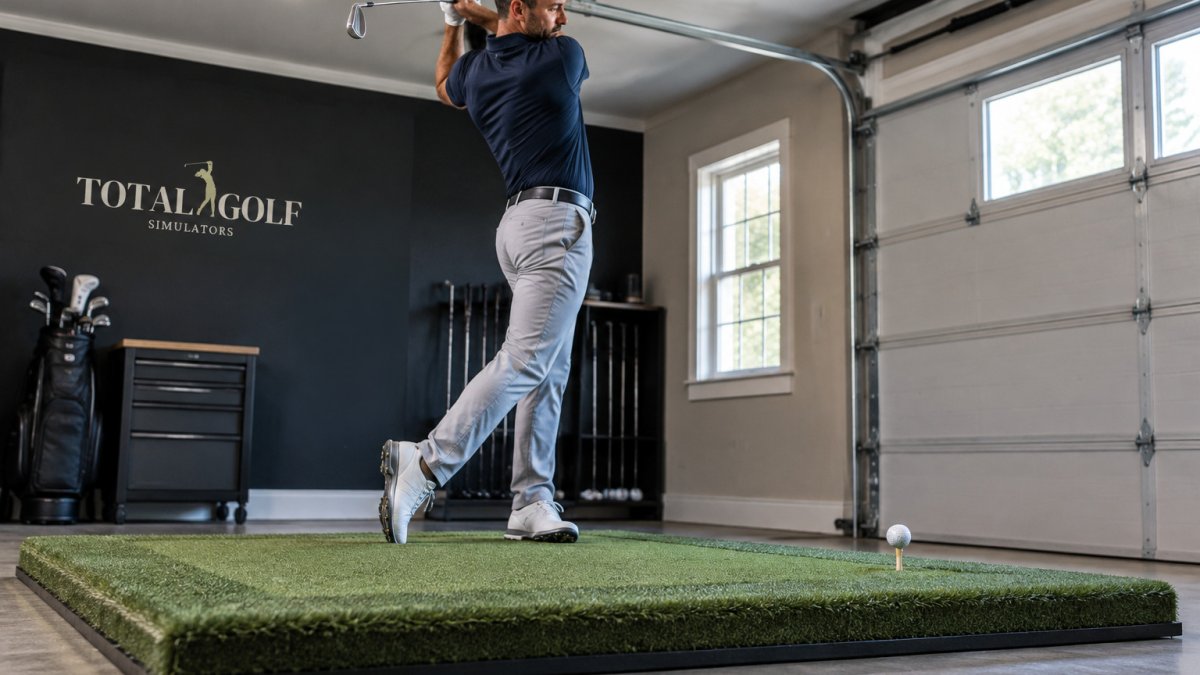
A common mistake is assuming any thick mat is automatically protective. Thickness alone does not guarantee cushioning. A dense, firm core can feel very different from a soft one, so look at the construction, not just the height. The Impact Sports mat's foam layer is designed to minimize club bounce and reduce strain on wrists, elbows, and shoulders.
What a mat can and cannot do is the part most buyers never hear. A shock absorbing mat can soften the peak force of each strike and reduce the vibration that reaches your hands and forearms. It cannot correct a steep, heavy swing, and it cannot make high-volume practice risk-free.
A practical way to think about safe practice volume is to treat the mat as a fatigue buffer rather than a license to hit more balls. Most practitioners find that a few short sessions with deliberate breaks beat one long block, especially on concrete.
Watch out: a soft mat can mask a steep downswing that keeps loading your joints, so pair cushioning with technique review rather than using thickness as a substitute for a sound swing.
Shock absorption also reduces wear on your clubs. Hard surfaces can chip wedge grooves and dent irons over time. A cushioned mat is gentler on equipment, and that protection adds to its long-term value. Keep sessions realistic. Even a well-cushioned mat will not protect you from a hard, poorly technique-driven swing repeated for hours. Pace your practice and treat the mat as one part of a sensible routine.
Mat thickness affects more than cushioning. It changes the height of your stance relative to the ball, the floor, and your launch monitor, and those relationships decide whether your simulator reads shots consistently. Most indoor hitting mats sit between roughly 1 and 1.75 inches thick. The Carl's Place Hot Shot mats are 1.75 inches thick, and the TallTurf Real Tee mats are about 1.5 inches thick.
Start with the relationship between the mat and your launch monitor. If your monitor sits on the floor beside a 1.75-inch mat, the ball is striking nearly two inches higher than the unit assumes, which can affect readings. The fix is usually simple: place the monitor on a platform or riser matched to the mat height, or choose a thinner mat that keeps the ball closer to floor level.
Stance-level alignment matters just as much. If your mat is thicker than the surrounding floor, you are standing on a raised platform while your monitor, screen, and enclosure sit at floor level. That mismatch can shift your sense of the target line and make it harder to reproduce a consistent setup.
Flooring underneath the mat changes the equation too. Concrete transmits impact and vibration efficiently, so a thicker foam core earns its keep on a bare slab. Carpet and rubber tiles already damp some vibration, which can let you choose a thinner mat without losing comfort.
Match thickness to your priorities. If joint comfort is the main goal, a thicker foam-core mat is worth the added height. If you have limited ceiling clearance or a low-profile setup, a thinner mat keeps your stance and ball flight closer to natural. Measure before you buy: check ceiling height, the space behind the hitting zone, and the clearance needed for your launch monitor and enclosure.
Watch out: buying a thick mat first and then discovering your monitor needs a riser is a common and avoidable sequencing mistake, so confirm monitor placement and stance alignment before you lock in thickness.
A hitting strip gives you a narrow zone for ball contact, while a full mat covers the whole stance area. Strips are compact and cost less, but they limit your ability to shift your weight and take a complete, natural swing. Full mats cost more but support the full swing you would make on a course.
The choice depends on your space and your goals. If you are practicing irons and wedges in a small room, a strip may be enough. If you want to work on drives and full-length woods, a full mat is the better investment. The TallTurf hitting mats are offered in 4x5, 4x9, and 5x10 sizes, so you can match the footprint to your room.
If you have a fixed space and a long-term plan, a full mat usually delivers more value over time. Strips make sense as a budget entry point, but plan to upgrade if your swing outgrows the surface.
Here is how the mats we carry compare on the factors that matter most to indoor buyers:
Mat |
Price (USD) |
Thickness / Build |
Best For |
|---|---|---|---|
Golf Bays Insert Tee Hitting Mat, 4'11" x 4'11" |
$549.40 |
Turf with shock-absorbing foam base |
Tee practice with consistent height |
Impact Sports 5' x 5' 3-Layer Real-Feel Mat |
$849.99 |
Turf, foam core, rubber base |
Premium cushioning and stability |
Carl's Place Hot Shot Hitting Mat |
$610.90 |
1.75" with replaceable foam or gel inserts |
Swapping feel without replacing the whole mat |
All Sports Systems TallTurf Real Tee Mat |
$425.00 |
About 1.5" thick, accepts regular tees |
Budget-conscious full-stance practice |
Price (USD)
Golf Bays Insert Tee Hitting Mat ($549.40). Pros: built-in insert tee system, a durable turf and foam base, and a compact footprint. Cons: the 4'11" x 4'11" size gives less lateral room than larger full mats. Best for: tee practice and consistent ball height in a smaller bay. Skip if: you need room for a long, full stance.
Impact Sports 5' x 5' 3-Layer Real-Feel Mat ($849.99). Pros: three layers, a shock-absorbing foam core, a rubber base for stability, and a quiet impact profile. Cons: the highest price in this group. Best for: serious golfers who want maximum cushioning and a stable surface. Skip if: you are on a tight budget or only practice short irons.
Carl's Place Hot Shot Hitting Mat ($610.90). Pros: interchangeable foam or gel divot inserts that can be swapped without replacing the mat, and multiple size options. Cons: you pay for the insert system, and the 1.75" height adds ceiling clearance needs. Best for: golfers who want to tune the feel over time. Skip if: you want one fixed surface and no maintenance decisions.
All Sports Systems TallTurf Real Tee Mat ($425.00). Pros: the lowest price here, accepts standard wooden or plastic tees, and comes in 4x5, 4x9, and 5x10 sizes. Cons: a single foam layer offers less cushioning than the three-layer design. Best for: budget-minded buyers who want a full stance. Skip if: joint protection is your top priority.
Start with your space. Measure your ceiling height, floor type, and the footprint you can give up. Then decide whether you need a strip or a full mat, and how much cushioning your practice demands.
Next, match the mat to your budget and goals. For tee work in a smaller bay, the Golf Bays insert tee mat fits well. For maximum cushioning on a full stance, the Impact Sports three-layer mat is the strongest option. For budget-friendly full-stance practice, the TallTurf mat delivers a lot of value.
Finally, plan your install. A rubber base keeps the mat stable, so confirm your floor will hold it in place. Total Golf Simulators can help you pick the right size and thickness for your room. Shop Golf Simulators to find the setup that fits your space.
Indoor simulator sessions often involve repeated full swings on the same spot, and a hard floor transmits that impact straight into the wrists, elbows and shoulders. A shock absorbing golf mat uses a foam or gel layer under the turf to soften each strike. The result can be less vibration in the joints over long practice sessions. For home golfers and instruction facilities alike, that comfort is what makes frequent practice sustainable.
A mat cannot prevent injury on its own, but it reduces the impact load that contributes to overuse strain. Foam and rubber layers absorb part of the force from each swing, which lowers the vibration reaching the wrists and elbows. Good form, a sensible warm-up and limiting total swings per session still matter. Treat the mat as one part of a safe practice routine rather than a guarantee against pain, and consult a qualified professional if joint discomfort persists.
A standard hitting mat is typically a turf surface on a thin base, which offers limited cushioning. A shock absorbing mat adds a dedicated foam core, gel layer or rubber base beneath the turf to soften impact and reduce club bounce. Thickness is a rough guide: many shock absorbing options are around 1.5 to 1.75 inches tall, while thinner mats transmit more force. Check the construction layers in each listing rather than relying on the word shock absorbing alone.
Thickness alone does not determine cushioning, because foam density and the base layer matter as much as height. That said, mats in the 1.5 to 1.75 inch range, such as the Carl's Place Hot Shot system at 1.75 inches, give a meaningful cushion while keeping the hitting surface stable. Thicker is not always better: very tall mats can make the ball and club interaction feel unnatural and may require adjusting your stance. Match the height to your swing style and ceiling clearance.
