
Customer Svc: 855-620-2330 -
M-Sat -9am-6pm
Speak To Customer Service - 855-620-2330 - M-Sat 9:00am - 6:00pm MST
Customer Svc: 855-620-2330 -
M-Sat -9am-6pm
Speak To Customer Service - 855-620-2330 - M-Sat 9:00am - 6:00pm MST

Last Updated: September 15, 2026
A Carl’s Place alternative for home simulators usually comes down to two frustrations: you cannot get the exact dimensions your room demands, and custom-build waits stretch longer than the golf season you are trying to extend.
Carl’s Place built its reputation on solid enclosures, but a fixed catalog rarely matches a real room. A basement with a low beam, a garage with a water heater in the corner, or a spare bedroom that doubles as a guest space all demand something the standard lineup does not offer.
Below: five enclosures worth considering, what each costs, and how to match a bay to your launch monitor, projector, and ceiling height.
A Carl’s Place alternative matters most when your space falls outside standard dimensions. Fixed-size enclosures force compromises: too wide crowds your swing, too narrow clips your follow-through.
Custom sizing changes that: several enclosures let you specify width, height, and depth to the inch, which matters when a ceiling joist or support column eats into your footprint.
Lead times are the other half of the equation. Custom fabrication adds weeks; a DIY frame ships far faster. To be hitting balls this month, prioritize in-stock sizing over made-to-order builds.
Entry-level DIY enclosures start around $999, while premium customizable kits run past $3,400 (How to build a golf simulator at home | Full Swing review). The gap buys thicker impact screens, better light-blocking fabric, reinforced frames, and room to reconfigure as your setup grows.
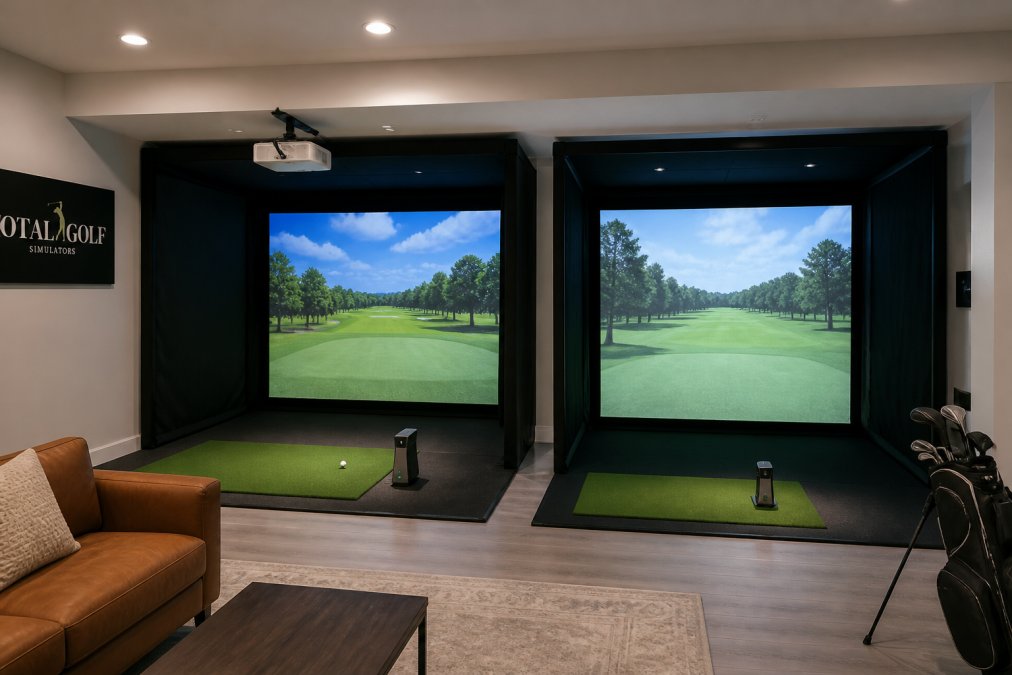
The five enclosures below cover the full range, from a sub-$1,000 starter bay to a retractable system that disappears into your ceiling.
Enclosure |
Starting Price |
Key Strength |
Best For |
|---|---|---|---|
$1,349.00 |
Upgrade paths, 5 sizes |
Builders who want to grow |
|
Impact Sports DIY Enclosure |
$1,342.00 |
Padding and poles included |
First-time DIY setups |
Golf Bays EasySim |
$999.00 |
Lowest cost, compact depth |
Tight budgets and spaces |
Carl's Place Pro (2025) |
$3,409.95 |
Custom sizing, BlackStop™ fabric |
Dedicated rooms |
Vanish Series Retractable |
$2,999.00 |
Rolls away in seconds |
Multi-purpose rooms |
The DIY Golf Enclosure System from All Sport Systems is the most flexible kit here. It starts at $1,349.00 and ships in five sizes across three screen tiers, with a 16:9 option for widescreen projection.

What sets it apart is the upgrade path: add a 1" EMT pole kit, foam wedge inserts, a baffle net, angled side netting, or top and side netting to protect ceilings, plus a sliding projector mount for cage-mounted projection without drilling into your ceiling.
EMT poles are not included by default, which keeps shipping costs down. Source 1" conduit locally or add the pole kit at checkout.
Impact Sports takes the opposite approach: everything arrives in one box. The $1,342.00 kit includes the complete pole system and interior pole padding at no extra cost.
The padding eliminates ball bounce-back, the most common safety complaint in home builds. Bungee-tensioned netting keeps the screen taut and lets you re-tighten as the fabric relaxes.
Sizes run from 8'2" x 4'11" x 8'2" up to 13'1" x 9'10" x 9'10". The Deluxe screen option adds a black-out back cover that cuts peripheral light and sharpens image clarity.
At $999.00, the EasySim is the most affordable enclosure here, built for rooms where depth is the constraint. Its compact 3'3" depth lets you swing comfortably in tighter spaces.
The package includes aluminum clicker tubing, black surround fabric, and an upgraded Lite impact screen, optimized for a 4:3 aspect ratio that simplifies projector selection.
Where it falls short: the Lite screen is not built for heavy commercial use, and the single aspect ratio limits widescreen projection. For a garage or spare room, nothing else at this price comes close.
The Pro Enclosure is the premium pick at $3,409.95, and the 2025 update earns the price. The redesigned moveable crossbar adjusts forward or backward during setup, so you can align radar or camera-based launch monitors without committing at checkout.
BlackStop™ imaging fabric darkens the interior, improving projector brightness, color depth, and contrast. The one-piece wraparound ceiling and sidewalls cut installation time by roughly an hour, and detachable 2" hook-and-loop flaps hold tighter with fewer wrinkles.
Custom sizing goes to the inch, with six standard sizes and four depth options, and frame heights reach 135 inches for larger rooms and commercial installs. One caveat: Carl's Place classifies these products as wearable, so there is no traditional warranty. Parts are replaceable, but plan for eventual screen replacement.
The Vanish Series solves a problem no fixed enclosure can: it disappears. At $2,999.00, this retractable system rolls up in seconds, converting your simulator bay back into living space.
Mounting brackets work on ceilings between 108" and 144", and screens sit 8 to 12 inches off the wall to protect the surface behind them. Power comes from a cord on each side, though hand-crank versions exist if no outlet is nearby.
The multi-sport attachment, sold separately, adds hockey, baseball, soccer, and lacrosse. It carries a 2-year warranty against defects in materials and workmanship.
Golf simulator room dimensions decide which enclosures are even possible. Standard guidance calls for roughly 10 feet of ceiling height, 10 to 12 feet of width, and 16 to 20 feet of depth to swing a driver safely (golfdigest.com).
Those are targets, not laws. Plenty of players make a 9-foot ceiling work with a compact enclosure and an adjusted setup position. The critical measurement is ball position to screen: too short risks a ricochet, too long and your projector may not fill the screen.
Measure these four things before ordering:
Factor |
Turnkey Package |
DIY Build |
|---|---|---|
Upfront cost |
Higher |
Lower |
Setup time |
Days |
Weeks |
Compatibility risk |
Minimal |
Your responsibility |
Upgrade flexibility |
Varies by vendor |
High |
Best for |
Busy buyers, commercial venues |
Hands-on builders |
What actually helps, in rough order of impact:
Several strong options exist. The DIY Golf Enclosure System starts at $1,349 and works with most launch monitors. The Impact Sports DIY Enclosure starts at $1,342 and includes poles and padding. The Golf Bays EasySim is the most affordable at $999. For a premium build, the Carl's Place Pro 2025 Model at $3,409.95 offers BlackStop fabric and a moveable crossbar. The Vanish Series Retractable Enclosure at $2,999 rolls away when not in use.
DIY enclosures like the Golf Bays EasySim ($999) use a Lite impact screen that handles regular play. Premium options like the Carl's Place Pro ($3,409.95) use multi-layer screens such as BlackStop fabric for sharper images and longer wear. If you play daily or run a teaching studio, the premium screen holds up better. For casual home use, a DIY kit delivers solid performance at a lower cost.
Focus on material layers, light blocking, and tensioning. A double-layer screen with a black back cover reduces light distortion and improves image clarity. Bungee tensioning keeps the screen tight over time. Foam inserts behind the screen reduce ball rebound. The Carl's Place Pro includes foam inserts and a premium screen. The Impact Sports Deluxe option adds a back cover for better contrast.
The Golf Bays EasySim at $999 is the lowest-cost full enclosure in this comparison. It includes aluminum tubing, a Lite impact screen, and black surround fabric. The DIY Golf Enclosure System starts at $1,349 and lets you add upgrades over time, such as a baffle net or foam wedges. Both options work with most launch monitors, so you can invest more in the tracking device and less in the enclosure.
Measure ceiling height, room width, and depth first. Most home enclosures need at least 8 feet of ceiling clearance. The Impact Sports enclosures start at 8'2" wide by 8'2" tall. The Vanish Series mounts to ceilings between 108 and 144 inches. Allow at least 8 to 12 inches of space behind the screen for safety. If your room is tight, a retractable option like the Vanish Series frees up floor space when not in use.