
Customer Svc: 855-620-2330 -
M-Sat -9am-6pm
Speak To Customer Service - 855-620-2330 - M-Sat 9:00am - 6:00pm MST
Customer Svc: 855-620-2330 -
M-Sat -9am-6pm
Speak To Customer Service - 855-620-2330 - M-Sat 9:00am - 6:00pm MST

Last Updated: September 30, 2026
The difference between a golf simulator that feels natural and one that frustrates you comes down to space. The most common mistake is underestimating the footprint required for a full swing.
A golf simulator room size for garage installations typically requires a minimum of 10 feet wide by 14 feet deep to accommodate a standard hitting bay with proper clearance for your stance and follow-through.
Space needs depend on three factors: launch monitor placement, enclosure dimensions, and swing clearance. A launch monitor too close to the mat creates sensor interference; positioned too far back wastes depth. Structural beams and garage door tracks add constraints.
Below, we'll show you exactly how to measure your garage, account for its specific challenges, and configure a golf simulator room size that actually works for your space and equipment.
The minimum ceiling height for a golf simulator is 10 feet; 11 feet is better. At 10 feet, you have roughly 12 inches of clearance after ball impact. At 11 feet, you can swing naturally without worrying about the ceiling.
If your garage ceiling is 8 feet or lower, you're limited to short-game practice (pitching, chipping) or swing trainers that restrict your backswing.
For vaulted or sloped ceilings, measure height at your standing position, not the highest point. Steep slopes shrink usable space quickly.
An enclosure creates a contained hitting zone that captures ball flight data and protects walls and equipment. Dimensions are driven by swing path, ball impact containment, and screen positioning.
Standard enclosures range from 8 feet wide by 12 feet deep (compact) to 10 feet wide by 14 feet deep (full-size). A 10-by-14-foot enclosure is the industry standard because it accommodates a natural stance, full swing path, and launch monitor placement.
For garages under 10 feet wide, an 8-foot enclosure works but constrains your stance slightly.
Garage depth is more critical than width. A 12-foot-deep enclosure is the minimum for a full swing; 14 feet deep provides comfortable room for the hitting mat, stance, and launch monitor.
Total Golf Simulators offers the DIY Golf Enclosure System in five sizes starting at 8 feet wide, with modular design for custom configurations.

Enclosure Size |
Width |
Depth |
Best For |
Launch Monitor Placement |
|---|---|---|---|---|
Compact |
8 ft |
12 ft |
Tight garages, short-game focus |
10-12 ft behind mat |
Standard |
9 ft |
13 ft |
Most residential garages |
12-14 ft behind mat |
Full-Size |
10 ft |
14 ft |
Spacious garages, full swing practice |
14-16 ft behind mat |
Width clearance matters less than depth. An 8-foot width feels tight for larger golfers; 10 feet provides freedom to adjust stance.
Depth clearance is critical. Add 3 to 4 feet behind the hitting mat for the launch monitor to get a clear view of the ball at impact. A 12-foot-deep enclosure leaves 6-7 feet for stance and backswing (tight but workable); 14 feet deep provides 12 feet of usable space (comfortable).
The impact screen distance from the wall should be 6 to 12 inches. This gap allows the screen to flex on impact, reduces bounce-back, extends screen life, and provides space for cable management.
Radar systems (SkyTrak) work best mounted overhead 10-14 feet behind the mat; camera-based systems (Foresight) need slightly longer distances.
DIY Golf Enclosure System w/Multiple →
Garages present unique constraints: garage door tracks, ceiling beams, concrete floors, and limited electrical infrastructure. Understanding these before you start prevents frustrating retrofits.
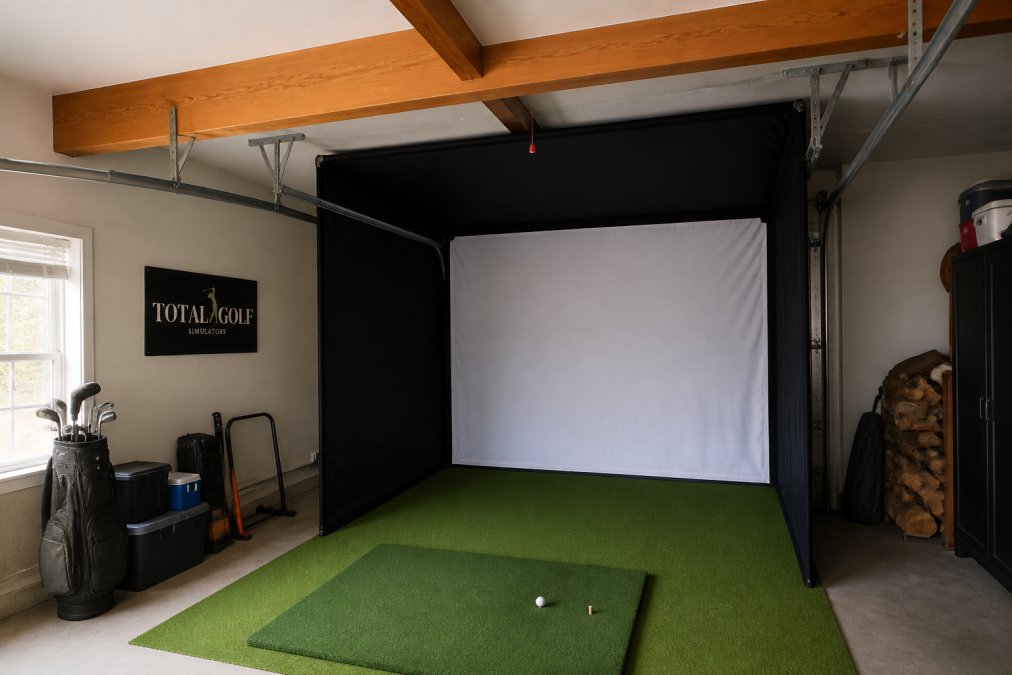
Garage door tracks run the length of the ceiling, typically 6-8 inches below the line. Position your enclosure forward so the launch monitor clears the track, which may sacrifice 1-2 feet of depth. Measure the track location before ordering an enclosure.
Concrete floors are hard and conduct sound. Use a 1/2-inch plywood sub-floor for shock absorption and insulation, topped with a quality hitting mat. Concrete wicks moisture, which can damage equipment; consider a concrete sealer or vapor barrier and dehumidification. The Golf Bays SimBox Enclosure is built to withstand garage moisture and temperature swings.
A golf simulator needs reliable power, adequate lighting, and climate control to function properly year-round. Garages often lack these amenities, so planning is essential.
Before you buy anything, measure your garage precisely. Mistakes here are expensive and time-consuming to fix.
Start with a tape measure and a notebook. Measure your garage in three dimensions: width (wall to wall), length (front to back), and ceiling height. Measure the ceiling height at multiple points, front, middle, and back, because many garage ceilings slope or have variations.
The most common mistake is underestimating the space needed for the launch monitor. People often position the enclosure as far back as possible to maximize depth, then realize the launch monitor has nowhere to go. Plan for the monitor first, then position the enclosure.
Not every garage can be a dedicated golf simulator space. Many people need their garage for cars, storage, or other purposes. In these cases, a portable or semi-permanent setup makes sense.
Most golfers need at least 9 feet of ceiling height for a full swing, though 10-11 feet provides more comfortable overhead clearance and accommodates taller players. If your garage ceiling is 8 feet or lower, you'll need to adjust your swing or consider a more compact setup with restricted follow-through. Launch monitors mounted overhead require additional clearance above the hitting mat—typically 8-9 feet minimum from floor to sensor.
Plan for at least 10-12 feet of width to accommodate lateral movement during your swing. A standard golf simulator enclosure typically occupies 8-10 feet of width, but you'll want additional buffer space on both sides for safety and natural body rotation. Narrower garages (under 10 feet wide) are still workable with compact enclosures, though your swing will feel slightly restricted.
Yes, most one-car garages (approximately 9-10 feet wide by 18-20 feet deep) can accommodate a golf simulator enclosure and hitting area. You'll lose parking space, but you gain a dedicated practice facility. The DIY Golf Enclosure System is available in multiple sizes starting at around $1,349, making it adaptable to various garage dimensions. Ensure you account for garage door swing clearance and any structural beams before finalizing placement.
Most setups place the hitting mat 10-15 feet from the impact screen to allow proper ball flight tracking and prevent screen interference from the launch monitor. Closer distances (8-10 feet) work for compact spaces but may reduce the realism of ball flight visualization. The exact distance depends on your launch monitor type—camera-based systems offer more flexibility in placement.
Concrete is the standard garage floor and works well for simulators, though it can be hard on your joints during long practice sessions. Consider adding a protective mat or sub-flooring layer to reduce impact stress and protect your concrete from hitting mat wear. Rubber interlocking tiles or foam underlayment improve comfort and help with shock absorption while protecting the floor from equipment weight and ball impacts.
Yes, proper lighting improves visibility of the impact screen and reduces eye strain during extended practice. Install LED lights on the ceiling or walls to eliminate shadows in your swing area. If using a projector-based simulator, ensure the enclosure blocks external light to maintain image brightness and clarity. Most garages benefit from 2,000-3,000 lumens of additional lighting focused on the hitting zone.
Portable options like the Impact Sports Collapsible Enclosure ($1,999) fold flat against the wall when not in use, ideal if your garage serves multiple purposes. Permanent setups using the Carl's Place Pro Enclosure ($3,409.95) or Golf Bays SimBox ($1,615) offer superior stability, durability, and a more professional appearance. Consider your long-term commitment to golf practice and whether you need garage flexibility before deciding.
Extreme temperature swings and humidity can damage launch monitors and projectors over time. Garages without climate control experience temperature fluctuations that may impact equipment accuracy and lifespan. If your garage gets very hot or cold seasonally, consider adding insulation, a small space heater, or dehumidifier to maintain stable conditions.