Customer Svc: 855-620-2330 -
M-Sat -9am-6pm
Speak To Customer Service - 855-620-2330 - M-Sat 9:00am - 6:00pm MST
Customer Svc: 855-620-2330 -
M-Sat -9am-6pm
Speak To Customer Service - 855-620-2330 - M-Sat 9:00am - 6:00pm MST

Last Updated: October 26, 2026
Quick Summary
A commercial golf simulator is worth it for retail only when you have surplus floor space, a golf-adjacent customer base, and enough weekly bookings to cover costs. In our worked example, break-even is about 255 booked hours per year, or roughly 5 hours per week.
A commercial golf simulator is worth it for a retail store only when the store has surplus floor space, a golf-adjacent customer base, and enough weekly bookings to cover equipment and operating costs within a reasonable window.
At Total Golf Simulators, we provide expert guidance and complete turnkey solutions for home and commercial environments. Below we break down the costs, the break-even math, and when to walk away.
The strongest signal is unused space you already pay rent on, a back corner holding seasonal overflow is the cheapest real estate you will ever convert.
The second is a customer base that already spends on golf.
The third is staffing you can stretch: someone must check players in, reset the bay, and handle the occasional technical hiccup.
If every square foot of your sales floor is productive, a simulator will cannibalize retail space and underperform.
If your customers are not golfers and have no reason to become golfers, the bay will sit empty on weeknights, the outcome that sinks most retail installs.
If you cannot absorb downtime, think twice. Screens wear, projectors need attention, and a dead bay earns nothing while you wait on parts.
The commercial golf simulator cost question has two halves: the equipment and the room around it. Most retailers budget for the first and forget the second. That is where projections go sideways.
Our package at $2,408.16 includes a choice of launch monitor, an impact screen, a hitting mat, and a projector. The package at $10,678.20 offers a choice of launch monitors, enclosure options, a hitting mat, and a projector.
The Modular Golf Simulator Bay Enclosure with Premium Panel Wall System is $6,850.00. The Vanish Series® Retractable Golf Enclosure is $2,999.00 and rolls up and out of the way in seconds.
You also need a computer that meets the software specs.
Retail golf simulator ROI comes down to one number: how many paid hours the bay books per week. Most retailers never build a real model, they compare equipment price to a vague sense of 'extra traffic' and guess. Build a break-even calculator with explicit inputs, then stress-test the assumptions.
The core equation is simple:
Break-even hours = Total annual fixed cost ÷ (Net revenue per booked hour)
Total annual fixed cost includes equipment amortization, allocated floor space, software, maintenance reserve, payment processing, and insurance. Net revenue per booked hour is your hourly rate minus variable costs (staff time, payment fees, consumables).
Here is a calculator-style example a retailer can adapt. Every number below is an assumption, not a quote, substitute your own.
Fixed costs (annualized):
Per-booking economics:
Break-even: $9,050 ÷ $35.54 ≈ 255 booked hours per year, or about 5 hours per week.
That is the number to beat. If your store cannot realistically book 5 paid hours a week, roughly one weekend evening plus a couple of weekday slots, the simulator will not pay back on direct rental alone.
A bay booked solid on weekend evenings and dead on Tuesday mornings averages out to mediocre revenue. Successful retailers fill slow hours with lessons, junior clinics, league nights, or discounted daytime rates. If your model assumes 10 hours a week but your realistic pattern is 6 peak hours plus 4 empty ones, you are overestimating net revenue by roughly 40%.
Golf demand in most U.S. markets peaks in late winter and early spring and again in the pre-holiday gift season; summer can soften as customers move outdoors. A simulator booking 12 hours a week in February may book 4 in July. Build your break-even on the annual average, not the peak month.
The simulator's direct rental revenue is only half the story, and the half that is easiest to measure. A customer who books an hour also walks past your shelves.
Red Stakes Golf RSG Pro Simulator Packages w/Optoma Projector →
To assess a possible lift, track average transaction size for customers who booked a bay versus those who did not. Do not assume a sales lift without evidence.
Two intangibles resist the spreadsheet: customer acquisition and retention. Treat these as upside, not as line items you need to justify the purchase.
The commercial golf simulator rental rate you set should reflect your market, your equipment, and your hours.
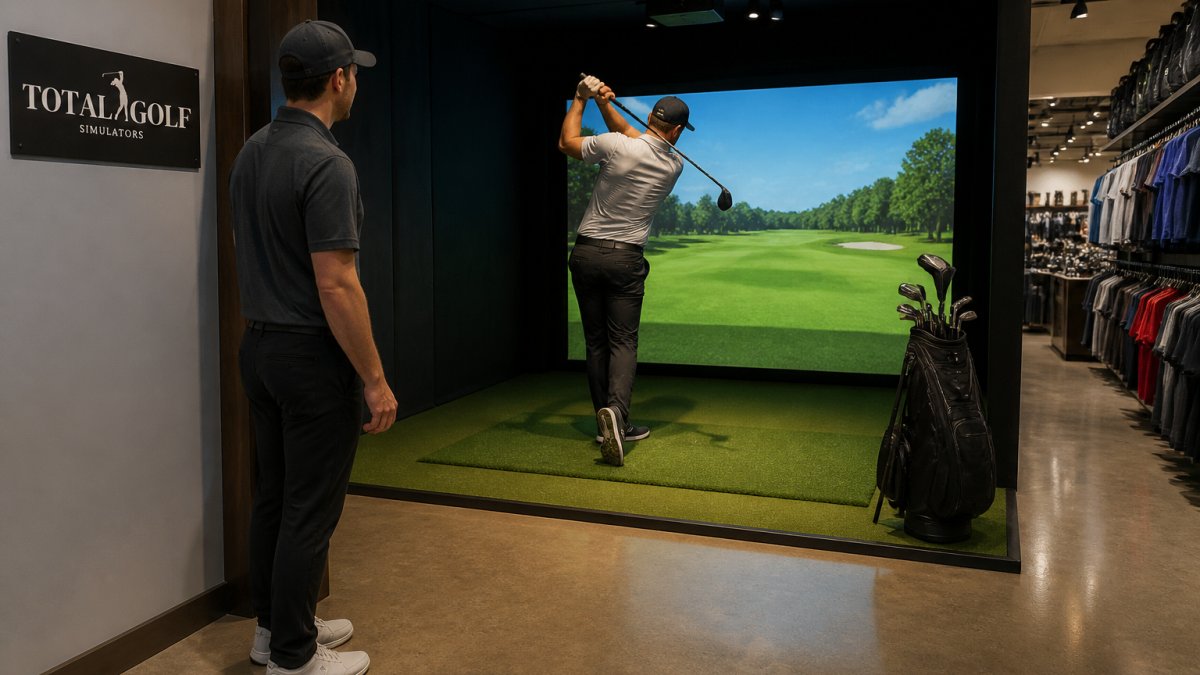
Use is where the plan lives or dies: a bay booking 20 hours a week at a modest rate can outperform a premium bay booking 8.
An empty bay at a premium rate earns less than a busy bay at a fair one.
Golf simulator operating costs should be considered alongside the upfront spend. For a detailed breakdown of ongoing maintenance costs, see Commercial Golf Simulator Maintenance Costs: Full Breakdown.
Operating costs to consider include:
A dead bay earns nothing while it is out of service. For a bay booking 8 hours a week at $35 net, a two-week delay would mean $560 in foregone direct revenue.
Attended model: staff check players in, reset the bay, and handle problems. It suits stores with existing floor staff and is safer for first-year operators; the cost is staff time and lost sales floor coverage.
Self-service model: customers book online, enter with a code, and run the bay themselves. This eliminates per-booking staff time and lets the bay operate outside store hours, but requires secure entry, clear instructions, remote monitoring, and a customer base that trusts the space.
Other considerations for a retail installation include:
Self-service access changes the economics: a bay customers can book and enter without staff on hand can run while your store is closed, lifting use without adding labor cost. The trade-offs are real, you need secure entry, clear instructions, and remote problem handling; a camera in the bay and a simple booking system cover most of it.
Before you commit to a full simulator bay, weigh the alternatives honestly.
What to skip: a bare launch monitor with no enclosure.
What to consider instead: a retractable enclosure like the Vanish Series® at $2,999.00, a real simulator experience without permanently giving up floor space.
What to consider if space is tight: a compact package built around a single launch monitor and a standard impact screen, sized to the room you actually have.
Match the package to the room and the customer, not the brochure.
Here is a simple way to decide:
Your Situation |
Recommended Package |
Why |
|---|---|---|
Testing the concept, tight budget |
Under $2.4K package at $2,408.16 |
Low entry cost, covers the essentials |
Established golf customer base |
$6K and Up package at $10,678.20 |
Premium launch monitor options, better accuracy |
Serious players, dedicated bay |
RSG Pro package at $12,249.99 |
Dual-camera tracking, lifetime software |
Space must serve double duty |
Vanish Series® enclosure at $2,999.00 |
Retracts out of the way in seconds |
Building around existing equipment |
Modular Bay Enclosure at $6,850.00 |
Premium panel walls, custom sizes |
Our team can help you match a setup to your space and budget, and our Simulator Finder Quiz can help match setups to space and budget.
The Flightscope/Red Stakes Golf Under $2.4K Golf Simulator Package is $2,408.16, the Flightscope/Red Stakes Golf $6K and Up Golf Simulator Package is $10,678.20, and the Red Stakes Golf RSG Pro Simulator Package is $12,249.99. The Modular Golf Simulator Bay Enclosure with Premium Panel Wall System is $6,850.00. Professional assembly is an optional $3,000 add-on for that enclosure. The Vanish Series® Retractable Golf Enclosure is $2,999.00 and rolls up and out of the way in seconds.
Payback depends on your hourly rate and how many hours the bay books each week. A single bay charging $40 per hour and booking 25 hours weekly grosses about $1,000 per week before operating costs. This is an illustrative calculation, not a payback estimate; actual results depend on costs and demand.
A simulator can provide an indoor golf environment for customers. The effect on retail sales depends on the store and its customers.
The RSG Pro package includes RSG CLUB™ software with no annual subscription fee; optional online multiplayer costs $199 per year. Other operating costs depend on the equipment and how the bay is used.
The Red Stakes Golf RSG Pro Simulator Package is $12,249.99 and includes lifetime access to RSG CLUB™ software with no annual subscription fee. Optional online multiplayer costs $199 per year. The supplied product information does not establish rental or leasing terms.
The real question is not whether a commercial golf simulator can work in a retail store. It is whether your store has the space, the customers, and the patience to run it as a business. If you have surplus floor and a golf-hungry clientele, the math can work. Total Golf Simulators offers turnkey packages with a price match guarantee, free shipping on most items, and expert guidance for commercial environments. Get started with Total Golf Simulators and build a bay that earns its square footage.
