
Customer Svc: 855-620-2330 -
M-Sat -9am-6pm
Speak To Customer Service - 855-620-2330 - M-Sat 9:00am - 6:00pm MST
Customer Svc: 855-620-2330 -
M-Sat -9am-6pm
Speak To Customer Service - 855-620-2330 - M-Sat 9:00am - 6:00pm MST

Last Updated: September 25, 2026
A luxury home golf simulator is a permanent, professionally integrated indoor golf environment that prioritizes shot-data fidelity, room aesthetics, and long-term serviceability over lowest upfront cost. The gap between a budget net-and-mat setup and a true luxury build comes down to three things: tracking accuracy, enclosure engineering, and how well the system disappears into your home when it isn't in use.
At Total Golf Simulators, we see this distinction play out in customer questions every week. The most common one: "I've seen setups online that look amazing, but people say the ball flight isn't realistic." That complaint almost always traces back to a budget launch monitor paired with a screen that reflects projector light back into the tracking cameras. The fix isn't a bigger budget. It's matching components that were designed to work as a system.
Here's what actually separates the tiers:
Below, we break down the requirements, the equipment decisions, and the design details that separate a system you'll use weekly from one you'll regret by spring.
Luxury golf simulator installation requirements start with three measurements: ceiling height, room depth, and available power. Get these wrong and no amount of premium equipment will save the build. Get them right and almost any room can work.
Nine feet is the practical floor for a full-swing simulator; ten feet is comfortable. Overhead-mounted launch monitors like the Uneekor Eye XO2 recommend roughly a 9-10 ft ceiling, mounted in front of the ball. The Vanish Series retractable enclosure mounts to ceilings between 108" and 144".

Floor space matters just as much as height. You need room behind the ball for your backswing, plus depth in front for ball flight before impact. A common mistake is measuring the room and forgetting the enclosure itself eats 5-15 ft of depth depending on configuration. Carl's Place Pro Enclosure depths run 5 ft, 8 ft, 10 ft, and 15 ft.
Plan for dedicated power at the enclosure, not an extension cord across the room.
Lighting is the other hidden variable.
The best golf launch monitors for 2026 indoor use are overhead camera-based systems, because they read the club and ball at impact rather than inferring data from flight. That's the short answer. The longer answer involves what you're actually trying to do with the data.
System |
Technology |
Data Points |
Starting Price |
Best For |
|---|---|---|---|---|
Uneekor Eye XO2 |
3 high-speed cameras + infrared |
24 |
$10,999.00 |
Teaching studios, elite home builds |
Uneekor Eye XO |
Dual high-speed cameras + infrared |
20+ |
$7,999.00 |
Tight rooms, home simulator rooms |
Eye XO2 "All In" Package |
Adds Swing Optix + Balance Optix |
24+ |
$12,399.00 |
Full swing-analysis setups |
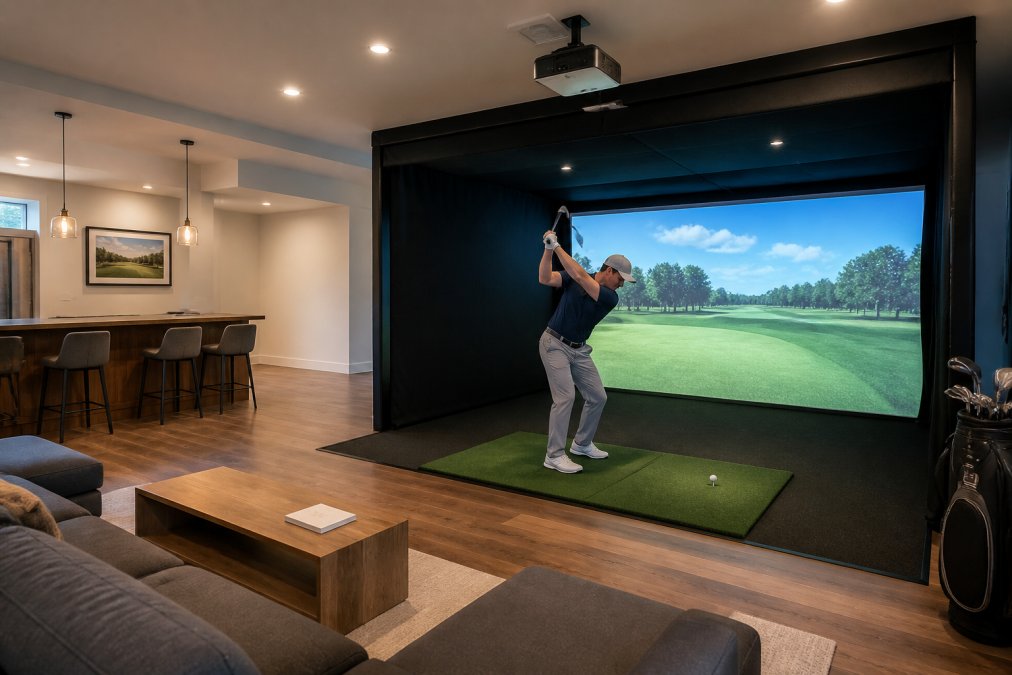
Integrating these sophisticated enclosures into a broader luxury home wellness environment ensures that your dedicated practice space functions as a seamless extension of your overall residential recovery and fitness architecture.
The Carl's Place Pro Golf Simulator Enclosure (2025 Model) is the benchmark for permanent installs. The 2025 revision adds a moveable crossbar you can adjust during setup for launch monitor alignment, BlackStop imaging fabric that darkens the interior for sharper projected images, and a one-piece wraparound ceiling and sidewall that cuts installation by nearly an hour. Price: $3,409.95.
If the room has to do double duty, this is where the category gets interesting.
Carl’s Place Pro Golf Simulator →
The visual layer is where luxury builds separate themselves from mid-tier ones, and it's the layer most buyers under-budget. A great launch monitor feeding a dim projector onto a wrinkled screen produces a system that feels like a video game. The fix is three components working together.
Custom home golf simulator design is the process of matching launch monitor, enclosure, projector, screen, and computer to your specific room dimensions, ceiling height, and intended use. It is not a shopping list. It's a set of constraints that eliminate most options before you start comparing.
A practical sequence:
Acoustics and finish are the two areas most guides ignore entirely, and they're exactly what turns a simulator room into a room guests actually want to spend time in. Impact screens absorb some sound, but a golf ball hitting a screen at speed is loud, and hard surfaces amplify it.
Post-purchase support is where the luxury category earns its price, and it's the question buyers ask most: "How do I know you'll actually support me if something goes wrong after installation?" It's a fair question, and the honest answer is that policies vary significantly by manufacturer and component.
A few things worth knowing before you buy:
Most luxury setups need at least 10 feet of ceiling height and roughly 15 feet of depth from the hitting area to the screen, though the exact numbers depend on your launch monitor and enclosure. The Vanish Series retractable enclosure mounts to ceilings between 108 and 144 inches and sits 8 to 12 inches off the wall. The Uneekor Eye XO2 recommends a 9 to 10 foot ceiling. Measure before you buy, and account for your full swing path, not just the ball.
It depends on your priority. The Uneekor Eye XO2 at $10,999 uses three high-speed cameras and captures 24 data points, including club path, face angle, and smash factor, with a 28-inch by 21-inch hitting zone. The Uneekor Eye XO at $7,999 delivers over 20 metrics with overhead infrared tracking and no floor unit to trip over. Both work with GSPro, E6 Connect, and TGC 2019, so software choice stays open.
Yes, in most cases. The Uneekor Eye XO2 recommends roughly 9 to 10 feet of ceiling height for overhead mounting, and the Vanish Series enclosure mounts to ceilings between 108 and 144 inches. If your ceiling is taller, 2-foot screen extensions are available. The main constraint is your swing, so check your driver path with a club before committing to a layout.
A complete build adds up across components. Enclosures start at $2,650 for a motorized drop-down system and $2,999 for the retractable Vanish Series, while the Carl's Place Pro Enclosure is $3,409.95. Launch monitors run $7,999 to $10,999. Projectors are $2,899 to $4,899, and a dedicated simulator computer is $4,699. A hitting mat like the Country Club Elite is $173.20, and a premium impact screen is $439.95.
For golfers who practice year-round and want data they can trust, yes. The Uneekor Eye XO2 records club path, face angle, dynamic loft, and smash factor, and its Dimple Optix and Club Optix features show spin and clubface orientation at impact. That level of feedback turns a home bay into a coaching tool. If you mainly want casual rounds, a lower-tier monitor may cover your needs.