
Customer Svc: 855-620-2330 -
M-Sat -9am-6pm
Speak To Customer Service - 855-620-2330 - M-Sat 9:00am - 6:00pm MST
Customer Svc: 855-620-2330 -
M-Sat -9am-6pm
Speak To Customer Service - 855-620-2330 - M-Sat 9:00am - 6:00pm MST

Last Updated: August 28, 2026
Most golfers who build a home simulator get the enclosure decision wrong. They buy a permanent frame setup, discover it dominates the room, and spend the next year working around it. The better answer is a retractable golf simulator enclosure, a system that gives you a full simulator bay when you want it and your space back when you don't. At Total Golf Simulators, we've helped hundreds of golfers configure setups that actually fit their lives.

Below, we'll break down every retractable and space-saving enclosure option currently available, what each one costs, where each one makes sense, and what most buyers overlook until it's too late.
A retractable golf simulator enclosure is a simulator bay system designed to fold, roll, or collapse when not in use, returning the room to its original function. Unlike fixed-frame enclosures that permanently occupy floor space, retractable designs mount to the ceiling or fold flat against a wall, making them ideal for multi-purpose rooms, shared garages, and any space where a permanent simulator bay isn't practical.
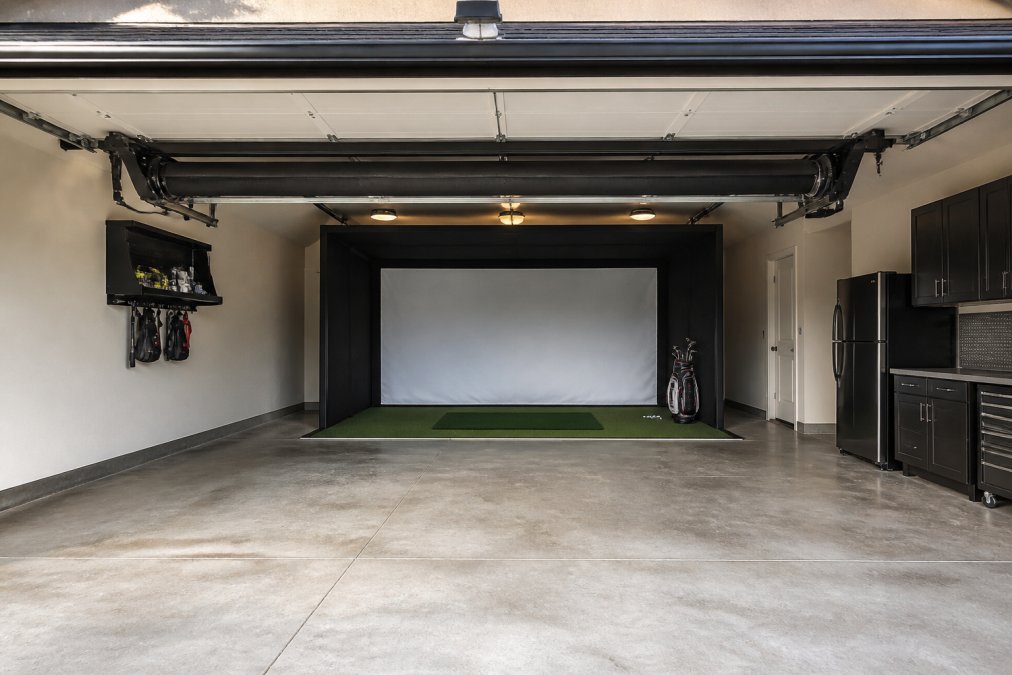
Motorized enclosures use an electric lift system, typically ceiling-mounted, to raise and lower the screen assembly via remote control. The Remote Control Motorized Drop Down Enclosure lowers the full 118" W x 118" H x 51" D hitting environment with one button press; another press retracts it to the ceiling.

Manual retractable options use hand-crank mechanisms or hinge-and-fold frames. The Vanish Series offers a hand-crank version for spaces without accessible power outlets. The Impact Sports Collapsible Foldable Enclosure uses a hinge-and-frame mechanism that folds flat against the wall without requiring electrical connection.
For high-frequency users, motorized is worth the premium. For home setups used a few times per week, manual systems are completely adequate and significantly cheaper.
Ceiling clearance is the single constraint that eliminates more options than any other. The Vanish Series mounts to ceilings between 108" and 144" (9 to 12 feet). For lower ceilings, the common 10-foot basement scenario, foldable wall-mounted systems like the Impact Sports Collapsible Enclosure become the more practical choice. Its 8'2" height fits comfortably under a standard 10-foot ceiling with room to spare.
A common mistake is measuring ceiling height at the center of the room and ignoring HVAC ducts, beams, or lighting fixtures that reduce usable clearance in the actual mounting zone. Measure the specific spot where the screen will hang.
Choosing the right retractable golf simulator enclosure comes down to three variables: how often you need the space back, how much installation complexity you can handle, and your ceiling configuration.
Enclosure |
Price |
Operation |
Best For |
|---|---|---|---|
Vanish Series Retractable |
$2,999 |
Motorized or manual |
Premium home setups, multi-purpose rooms |
Remote Control Motorized Drop Down |
$2,650 |
Motorized (remote) |
Garages, commercial bays |
$1,999 |
Manual fold-flat |
Basements, shared spaces |
|
Golf Bays SimBox |
$1,615 |
Fold-down storage |
Home use, moderate frequency |
DIY Golf Enclosure System |
$1,349 |
Manual assembly |
Custom builds, serious DIYers |
Impact Sports DIY (Padding & Poles) |
$1,342 |
Manual assembly |
Budget-conscious home setups |
Golf Bays EasySim |
$999 |
Manual assembly |
Entry-level, tight spaces |
The Vanish Series is the world's first purpose-built retractable golf enclosure. The roll-up design stores the entire screen assembly overhead in seconds. It ships with a rear impact support membrane, premium 3-ply impact screen, two side screens with 5-foot depth, ceiling panel, corner pieces, side baffles, front baffle, and all mounting brackets. The universal bracket system mounts to either ceiling or wall. Screen sizes span from the Vanish 9 (89" W x 89" H projectable area) up to the Vanish 16H (183" W x 103" H projectable area). Power connects via standard 110V outlets. The hand-crank version handles retraction manually where power isn't accessible. The 2-year warranty covers defects in materials and workmanship.

Best for: Home setups where the room serves multiple purposes and aesthetics matter.
This is the most practical motorized option for garage golf simulator setups. The 118" W x 118" H x 51" D hitting area is spacious enough for a full swing without crowding. The remote-controlled lift system raises and lowers the screen assembly without manual handling. The structure uses three main shafts (118" each) and two side shafts (51" each), ceiling-mounted via brackets, iron plates, and screws. The impact screen and side blackout fabrics attach via heavy-duty Velcro, making screen replacement straightforward.
Best for: Garages where the space doubles as a workshop or parking area. The ceiling-mount design keeps the floor completely clear when retracted.
The Impact Sports Foldable Enclosure folds flat against the wall instead of rolling to the ceiling. Dimensions are 9'10" W x 8'6" D x 8'2" H (with a compact 4'1" depth option), making it one of the few retractable options that works in rooms with ceilings under 9 feet. The high-density safety padding and bungee tension system handle impact absorption and minimize bounce-back. It's compatible with popular launch monitors including SkyTrak, Foresight, and Garmin-based systems.
Best for: Basements and multi-use rooms with lower ceilings.
The Golf Bays EasySim ($999) is the entry point: aluminum clicker tubing, integrated black surround fabric, and a Lite impact screen in a 10'9" W x 8'2" H x 3'3" D footprint. Setup is tool-free.
The Impact Sports DIY Enclosure with Padding & Poles ($1,342) includes high-density padded frames, bungee-tensioned netting, and multiple size options ranging from 8'2" x 4'11" x 8'2" to 13'1" x 4'11" x 8'2".
The Golf Bays SimBox ($1,615) ships with a PRO+ premium HD/4K impact screen, uses a click-tube aluminum frame that assembles in approximately 45 minutes without tools, and folds down for storage.
Garage golf simulator setup requirements follow a predictable hierarchy: ceiling clearance first, swing width second, depth third. Most single-car garages run approximately 10 to 12 feet wide and 20 feet deep, which is workable but tight. Two-car garages at 18 to 20 feet wide give you proper enclosure width plus room to position a launch monitor correctly.
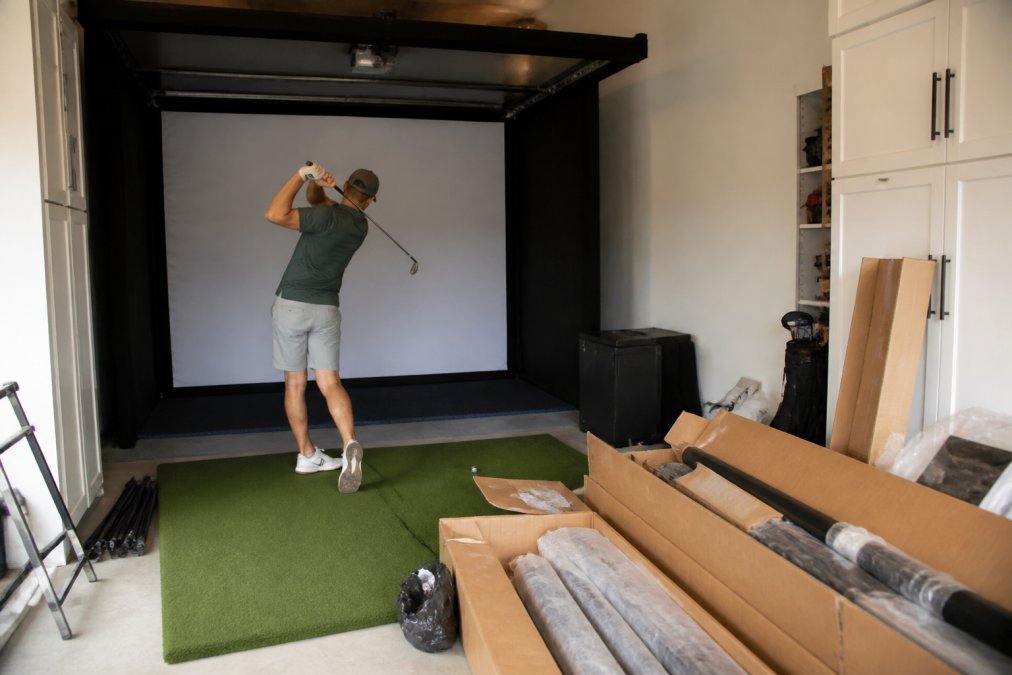
The minimum ceiling height for a comfortable swing is generally accepted as 9 feet for most golfers (pga.com). Taller players or those with high swing planes need 10 feet minimum. At a 10-foot basement ceiling, the Impact Sports Collapsible Foldable Enclosure at 8'2" H and the EasySim at 8'2" H both clear with margin.
According to National Golf Foundation's participation research, home golf practice installations have grown substantially as golfers seek year-round options outside of traditional range visits.
DIY installation on a foldable or manual enclosure is manageable for anyone comfortable with basic tools and ceiling anchoring. The Golf Bays EasySim and SimBox require no tools at all for the enclosure frame itself.
Motorized ceiling-mount systems require secure ceiling anchoring rated for the combined weight of the system, proper electrical access, and precise alignment for the screen to lower and retract cleanly. For most homeowners without prior ceiling-mount experience, professional installation is worth the cost.
A practical decision framework:
The best golf simulator impact screen material for retractable systems balances projection quality, impact durability, and the physical stress of repeated folding or rolling. Standard single-layer screens work adequately for low-frequency home use. For systems that deploy and retract daily, multi-layer construction is the minimum to specify.
The Golf Bays SimBox PRO+ screen uses triple-layer construction, the same spec used in heavy commercial environments. For retractable systems specifically, screen tensioning matters more than in fixed frames. The Vanish Series uses a roll-up mechanism that maintains consistent tension across the screen face. The Impact Sports systems use bungee tensioning, which allows the screen to be re-tensioned as the material relaxes over time.
Acoustic dampening is critical in garage or basement setups. A golf ball striking an impact screen at full swing speed generates significant impact noise that transfers to adjacent living spaces. The Impact Sports Collapsible Foldable Enclosure prioritizes quiet impact absorption with high-density safety padding that absorbs energy at the frame contact points, reducing secondary vibration.
Beyond the enclosure itself, acoustic panels on the surrounding walls reduce echo and ambient noise. This DIY addition costs relatively little but meaningfully improves the experience in hard-surfaced garage spaces.
Retractable enclosures require more deliberate maintenance than fixed frames because the folding and rolling mechanisms accumulate debris over time.
For roll-up systems like the Vanish Series, inspect the roll mechanism monthly for dirt, dust, or fabric debris that can cause uneven retraction. Check bracket mounting points every three to six months, as motorized systems create vibration that can work hardware loose.
For fold-flat systems, lubricate hinges with a silicone-based lubricant annually. Check that the bungee tensioning system hasn't stretched to the point where screen tension is noticeably reduced; bungee cords typically need replacement every two to three years under regular use.
No mat perfectly replicates real turf, but the gap has narrowed significantly with premium options. For simulator use specifically, the mat's primary job is providing a stable, repeatable hitting surface that doesn't interfere with launch monitor readings. Mats with thick foam backing or elevated tee inserts can create lie angles that differ from real grass, which affects ball flight data.
Choose a mat with a natural grass texture layer over a firm foam base. Avoid ultra-thick mats that raise the ball significantly above the floor level, as this changes the effective lie angle and can skew launch monitor data.
Launch monitor compatibility is non-negotiable. Radar-based launch monitors need clear line of sight behind the ball's flight path (peer-reviewed research). Some enclosure designs, particularly those with low side baffles or deep side panels, can interfere with radar beam travel. The Carl's Place Pro Enclosure's adjustable crossbar system specifically addresses this by allowing forward or backward positioning to achieve perfect alignment for both radar and camera-based tracking systems.
Camera-based launch monitors require specific floor positioning relative to the ball and screen. The enclosure depth determines how much room exists between the hitting position and the screen face. The Remote Control Motorized Drop Down Enclosure's 51" depth provides adequate clearance for most camera-based systems. The EasySim's 3'3" depth is tighter and may limit positioning options for some launch monitor models.
The right retractable golf simulator enclosure for your space comes down to four decisions made in sequence.
Step 1: Confirm your ceiling clearance. Measure the usable height at the exact mount point, accounting for any obstructions. Under 9 feet: fold-flat systems only. 9-10 feet: fold-flat or low-profile motorized. Over 10 feet: full range of options including ceiling-mount motorized systems.
Step 2: Decide on retraction mechanism. If you need the space back daily and have power access at the ceiling, motorized is the right choice. If the simulator runs several times per week in a dedicated area, manual fold-flat is adequate and simpler.
Step 3: Set your budget against your use case. Home setups used a few times per week can be well-served by the $999-$1,615 range. Daily-use home setups justify the $2,000-$3,000 range.
Step 4: Confirm launch monitor compatibility before purchasing. Check whether your launch monitor is radar-based or camera-based, and verify that the enclosure depth and side panel configuration won't interfere with tracking.
Scenario |
Recommended Enclosure |
Price |
|---|---|---|
Multi-purpose living room, 10'+ ceiling |
Vanish Series Retractable |
$2,999 |
Garage, daily use, power available |
Remote Control Motorized Drop Down |
$2,650 |
Basement, 10' ceiling, wall-fold preferred |
Impact Sports Collapsible Foldable |
$1,999 |
Home garage, moderate use, HD screen priority |
Golf Bays SimBox |
$1,615 |
Budget build, custom sizing needed |
$1,349 |
|
Entry-level, tight space, tool-free setup |
Golf Bays EasySim |
$999 |
Building a home golf simulator that actually fits your space is harder than it looks. The enclosure decision alone eliminates most setups that look good in photos but fail in practice. Total Golf Simulators specializes in matching the right enclosure, launch monitor, hitting mat, and projector to your specific ceiling height, room configuration, and usage pattern. Use the Simulator Finder Quiz to get a matched recommendation, or browse the full enclosure range to find the retractable system that fits your build.
A: A retractable golf simulator enclosure lets you reclaim your room or garage when you're not practicing. Permanent enclosures offer a more rigid frame structure but occupy floor space around the clock. Retractable and foldable designs, like the Vanish Series or the Impact Sports Collapsible Enclosure, fold flat or roll up to the ceiling in seconds, making them ideal for multi-purpose rooms, garages, and basements where every square foot matters.
A: Most standard two-car garages offer enough ceiling clearance and floor space for a retractable enclosure. You'll need at least 9 feet of ceiling height, roughly 10–12 feet of width, and about 4–5 feet of depth behind the hitting position. The Remote Control Motorized Drop Down Enclosure, for example, requires a 118-inch-wide ceiling mount and a 51-inch depth, which fits comfortably in most single-bay garage setups.
A: Prioritize multi-ply construction for durability against repeated high-velocity ball strikes, and look for screens rated for both HD and 4K projection. Noise and bounce-back performance matter as much as image quality, especially in shared living spaces. Also confirm the screen tensioning system, whether bungee or Velcro, keeps the surface taut over time to maintain sharp projection quality.
A: Retractable enclosures use one of two mechanisms: motorized roll-up systems controlled by a remote, or manual fold-flat frames that collapse against a wall. Motorized versions, like the Remote Control Motorized Drop Down Enclosure, mount to the ceiling and lower the impact screen and side baffles into position at the press of a button. Foldable designs use a hinge-and-frame system that deploys in minutes without permanent installation, making them a flexible option for shared or multi-use spaces.
This article was written using GrandRanker