
Customer Svc: 855-620-2330 -
M-Sat -9am-6pm
Speak To Customer Service - 855-620-2330 - M-Sat 9:00am - 6:00pm MST
Customer Svc: 855-620-2330 -
M-Sat -9am-6pm
Speak To Customer Service - 855-620-2330 - M-Sat 9:00am - 6:00pm MST

Last Updated: October 6, 2026
Building a golf simulator in a small room doesn't mean settling for poor performance. The challenge is finding enclosures engineered for shallow depths and low ceilings without sacrificing containment or screen quality.
At Total Golf Simulators, we've helped golfers convert basements, spare bedrooms, and narrow garages into practice spaces. Three factors decide success: enclosure depth, ceiling clearance, and frame impact absorption.
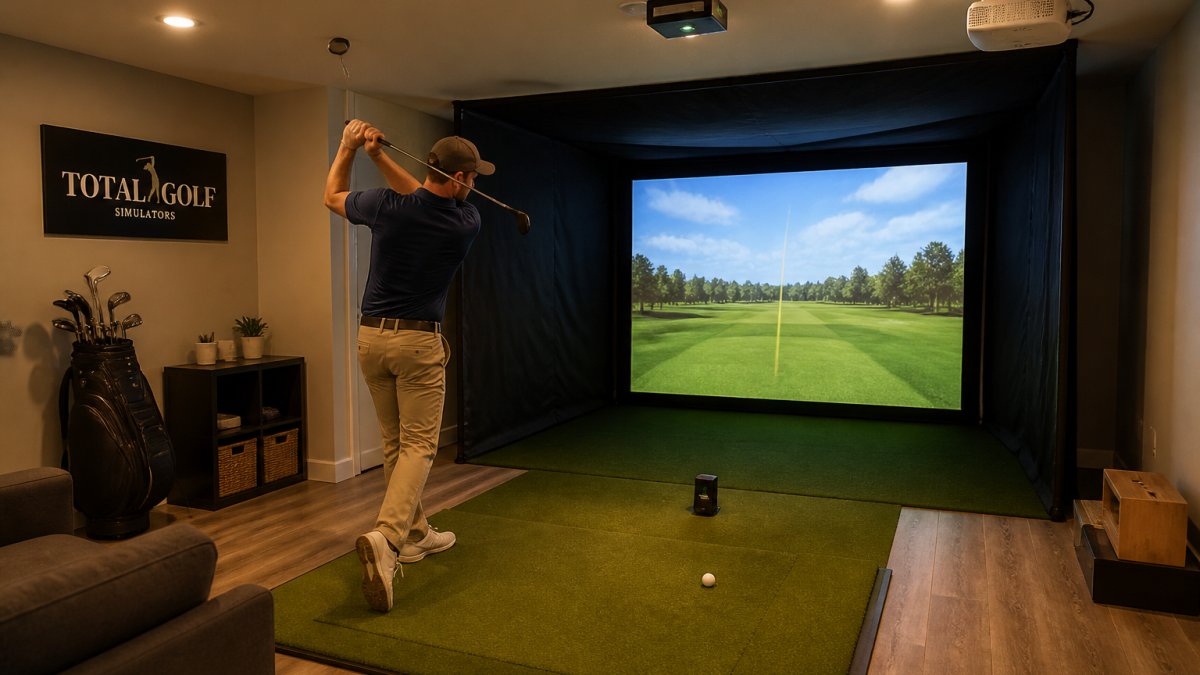
This guide covers the 5 best golf simulator enclosures for tight spaces, ranked by how well they solve real space constraints, with dimension specs, honest tradeoffs, and a room-layout framework.
Enclosure |
Depth |
Ceiling Height |
Price |
Best For |
|---|---|---|---|---|
8'6" |
8'2" |
$1,999 |
Multi-use rooms needing storage |
|
Golf Bays EasySim |
3'3" |
8'2" |
$999 |
Shallow spaces, budget-conscious |
Carl's Place DIY |
Variable |
8.5'+ |
$1,150 |
Customizable tight layouts |
Vanish Series Retractable |
5' (standard) |
9-12' |
$2,999 |
Living spaces, dual-purpose rooms |
DIY Golf Enclosure System |
Variable |
8'+ |
$1,349 |
Unconventional room shapes |
The Impact Sports enclosure solves the problem most tight-space builders face: a professional simulator setup that doesn't consume your room permanently.

It folds flat against the wall like a murphy bed, so you get a real enclosure without the footprint penalty. The 8'6" depth suits most basements, and the bungee tension system keeps the impact screen taut.
What works: High-density safety padding absorbs impact, and the bungee system minimizes bounce-back noise. Compatible with SkyTrak, Foresight, and Garmin.
What doesn't: At $1,999, it's a premium option.
Room fit: Works in any basement or garage with 8'6" ceiling clearance and 10+ feet of width. The footprint when deployed is roughly 10'W x 8.5'D.
If your depth is genuinely constrained, say a 12-foot room needing 2 feet for projector throw and 2 feet of buffer, the EasySim is built for exactly that.
The 1-meter (3'3") depth is the shallowest golf simulator enclosure designed for real swing practice. The 4:3 aspect ratio simplifies projector selection, no hunting for a pricier 16:9 short-throw model.
The Lite impact screen delivers a crisp, clear image with minimal noise on impact, and the black fabric surround is included.
What works: Affordable at $999, includes aluminum poles and all fittings, and assembles easily. The compact footprint fits spaces other enclosures can't, and the 4:3 ratio means cheaper projectors.
What doesn't: You'll need a low-throw projector (0.5:1 ratio), and overhead launch monitor mounting is nearly mandatory.
Room fit: Minimum 12-foot room depth (2 feet for projector, 3'3" for enclosure, 6 feet for hitting zone buffer). Ceiling height of 8'2" is adequate. Best for rooms narrower than 15 feet total depth.
Carl's Place offers flexibility for unconventional room shapes: source your own 1" EMT conduit (or buy their pole kit), assemble the frame, and stretch the nylon enclosure over it.
What works: At $1,149.95, it is a budget-friendly option, fully customizable, and the gray screen is designed for rooms with ambient light. Heavy-duty black nylon walls and ceiling panels are included, and it works with most launch monitors.
What doesn't: Poles are sourced separately (or cost more as a framing kit), adding complexity if you're not comfortable with basic construction.
Room fit: Adaptable to any basement layout. Recommended minimum ceiling height is 8.5 feet. Best for rooms where standard enclosure dimensions don't match your available space.
The Vanish Series is a retractable golf enclosure, engineered for rooms where the simulator can't dominate the space. Its sleek, roll up, innovative design allows you to effortlessly switch between a professional golf simulator setup and an open living space. The 2-year warranty and construction-grade materials mean it's built for durability. Mounting flexibility matters in tight spaces: brackets work on ceiling or wall, and 8-12 inches of space behind the screen is recommended.

What works: Rapid retraction saves floor space permanently, and the patent-protected design handles high-velocity shots without degradation. Ceiling mounting options (108-144 inches) work in most homes, and side screens plus ceiling panels complete the enclosure.
What doesn't: At $2,999, it's the most expensive option. The 5-foot standard depth is included. Without power at your mounting location, you'll need the hand-crank option.
Room fit: Requires 9-12 foot ceiling clearance and wall space for bracket mounting. The retractable mechanism needs 8-12 inches of clearance behind the screen. Best for living rooms or dens where the simulator is temporary.
The DIY Golf Enclosure System from All Sport Systems offers five sizes plus custom sizing.

It ships with a high-quality impact screen, RipStop black wrapper, and replaceable trim sleeves.
The RipStop black wrapper is included, and the upgrade path is available.
What works: Five standard sizes mean you'll find something close to your dimensions without custom fabrication costs. The upgrade ecosystem includes various options, and modular construction lets you expand later.
Impact Sports - Space Saving Collapsible Enclosure - Custom Sizes Available →
What doesn't: EMT poles aren't included, adding cost and complexity if you're not comfortable sourcing conduit. It requires 5-foot minimum depth, and assembly is more involved than pre-assembled options.
Room fit: Best for rooms with 8+ foot ceilings and at least 5 feet of usable depth. The five standard sizes accommodate most basement and garage layouts. Custom sizing is available for truly unconventional spaces.
Before buying an enclosure, measure your actual available space. Most tight-space builds fail here: golfers estimate dimensions, order equipment, and discover 6 inches of clearance doesn't exist.
Start with the full room dimensions: length, width, and ceiling height. Then subtract what's actually usable.
Ceiling height: measure floor to the lowest obstruction (HVAC ducts, beams, light fixtures). Most enclosures need 8-8.5 feet minimum.
Room length: subtract 2-3 feet for projector throw distance (depends on throw ratio) and another 2 feet as a buffer behind the enclosure. What remains is your maximum enclosure depth.
Example: an 18-foot basement minus 3 feet for projector throw and 2 feet buffer leaves 13 feet. The EasySim (3'3"), Impact Sports (8'6"), and Vanish Series (5-foot) all fit with room to spare.
Room width: most enclosures are 9-10 feet wide. Narrower rooms are limited to DIY options with custom-sized frames. A 12-foot-wide basement fits a standard enclosure with 1-2 feet of clearance per side; 10 feet is tight but workable.
Enclosure depth is the critical variable for tight spaces, the distance from the impact screen back to where you stand when you swing.
The industry standard is 10-12 feet from golfer to screen for realistic ball flight perception, often impossible in tight rooms. The EasySim at 3'3" is designed to maximize flexibility in tighter spaces.
If your total room depth is 15 feet or less, you have options such as the EasySim, the Carl's Place DIY with custom sizing, or the DIY Golf Enclosure System configured for minimal depth. The Impact Sports and Vanish Series are also available.
The enclosure is only part of the equation. Where you position the hitting mat, launch monitor, and projector determines whether your simulator feels realistic or cramped.
Your hitting position should be 10-12 feet from the impact screen for optimal ball flight simulation, letting the launch monitor capture ball data and your eyes perceive depth on the virtual course.
In tight rooms you'll compromise: the EasySim has a 3'3" depth, the Carl's Place DIY can be configured, and the Impact Sports (8'6" depth) and DIY Golf Enclosure System can be considered.
Elevate the hitting mat slightly (0.5-1 inch) to match natural ground height and center your stance in the enclosure width, roughly 5 feet from either side wall in a 10-foot-wide enclosure.
Radar-based launch monitors (like SkyTrak or Foresight) need a clear line of sight to the ball. Overhead mounting is often used to keep the monitor out of your swing path. Camera-based launch monitors (like Uneekor) are also compatible. Projector placement depends on throw ratio: a standard throw (1.2:1) needs 12-15 feet from the screen, while a short-throw model (0.5:1) at 4-6 feet is often used in tight basements. In tight spaces, using vertical space (ceiling mounts) instead of floor footprint is often recommended.
Choosing among the 5 best golf simulator enclosures for tight spaces depends on three factors: how shallow your room actually is, whether the setup must be temporary or permanent, and your budget.
If your room depth is 15 feet or less, consider the EasySim, which is designed for shallow spaces. At $999, it is an affordable option.
If you need to fold or retract the enclosure, the Impact Sports ($1,999) or Vanish Series ($2,999) are available options.
For unconventional shapes, narrower-than-standard rooms, or obstacles forcing custom sizing, the Carl's Place DIY ($1,150) or DIY Golf Enclosure System ($1,349) build exactly what fits.
Total Golf Simulators stocks all five of these enclosures and can help you measure your space to find the right fit.
Building a golf simulator in a tight space requires honest assessment of your room's dimensions and realistic expectations about ball flight perception.
The smallest practical golf simulator enclosure fits into spaces with a minimum depth of 3 feet and width of 8 feet. The Golf Bays EasySim enclosure (10'9" x 8'2" x 3'3") is specifically designed for tight spaces with its compact 1-meter (3'3") depth, allowing comfortable swings even in shallow rooms. However, you'll need at least 12-15 feet of total room depth to account for the hitting position, ball flight distance, and projector placement.
Yes, a 10-foot ceiling works for most golf simulator enclosures. The Impact Sports Collapsible Enclosure and Golf Bays EasySim both fit within 8'2" to 8'6" height, leaving adequate clearance. The Vanish Series retractable enclosure mounts between 108" (9 feet) and 144" (12 feet), so a 10-foot ceiling is ideal. The key is measuring your exact ceiling height and accounting for any fixtures like light fixtures or HVAC ducts that might intrude into the enclosure space.
Impact screens in tight-space enclosures must balance durability with minimal bounce-back. The Golf Bays SimBox includes a PRO+ Premium Impact Screen as Standard, which has high ratings for durability and noise reduction. The Carl's Place DIY enclosure offers a High-Contrast Gray screen designed to enhance brightness and realism in rooms with ambient light. Materials like heavy-duty polyester and multi-ply construction are often used to absorb impact energy, reducing both noise and ball rebound.
All enclosures listed here are compatible with major launch monitor types (SkyTrak, Foresight, Garmin Approach R50, Uneekor). The Impact Sports Collapsible Enclosure explicitly supports SkyTrak, Foresight, and Garmin systems. The key is ensuring your launch monitor's camera or radar has clear sight lines to the ball and screen. In tight spaces, overhead-mounted launch monitors work best. Before purchasing, verify your monitor's mounting requirements and confirm the enclosure's frame design allows your preferred mounting position.