
Customer Svc: 855-620-2330 -
M-Sat -9am-6pm
Speak To Customer Service - 855-620-2330 - M-Sat 9:00am - 6:00pm MST
Customer Svc: 855-620-2330 -
M-Sat -9am-6pm
Speak To Customer Service - 855-620-2330 - M-Sat 9:00am - 6:00pm MST

Quick Summary
The best indoor golf practice drills for beginners are short, measurable routines that build posture, alignment, tempo and impact. Start with no-equipment drills like the towel connection drill and mirror posture hold, then add tempo, impact and chipping drills with a hitting mat and a clear benchmark for each.
A workable indoor golf practice space needs enough ceiling height for full swings with a driver, along with clear width and depth around your hitting spot. Many beginners underestimate the room they need, so measure before you buy anything. A garage, basement or spare room can all work with the right layout.
Start by marking your hitting zone. Place a hitting mat on a flat, non-slip surface, then mark a target line on the wall or a net about 8 to 10 feet away. This gives you a consistent reference for alignment and swing path work. Keep the area clear of furniture, light fixtures and anything you would not want struck.
Safety comes first. Use a netted enclosure or impact screen whenever you hit balls, and never practice with a live ball in a room with windows, breakable décor or people walking through. A simple checklist helps:
Watch out: many beginners place the mat too close to the wall, which leaves no room for the follow-through and invites club strikes on drywall.
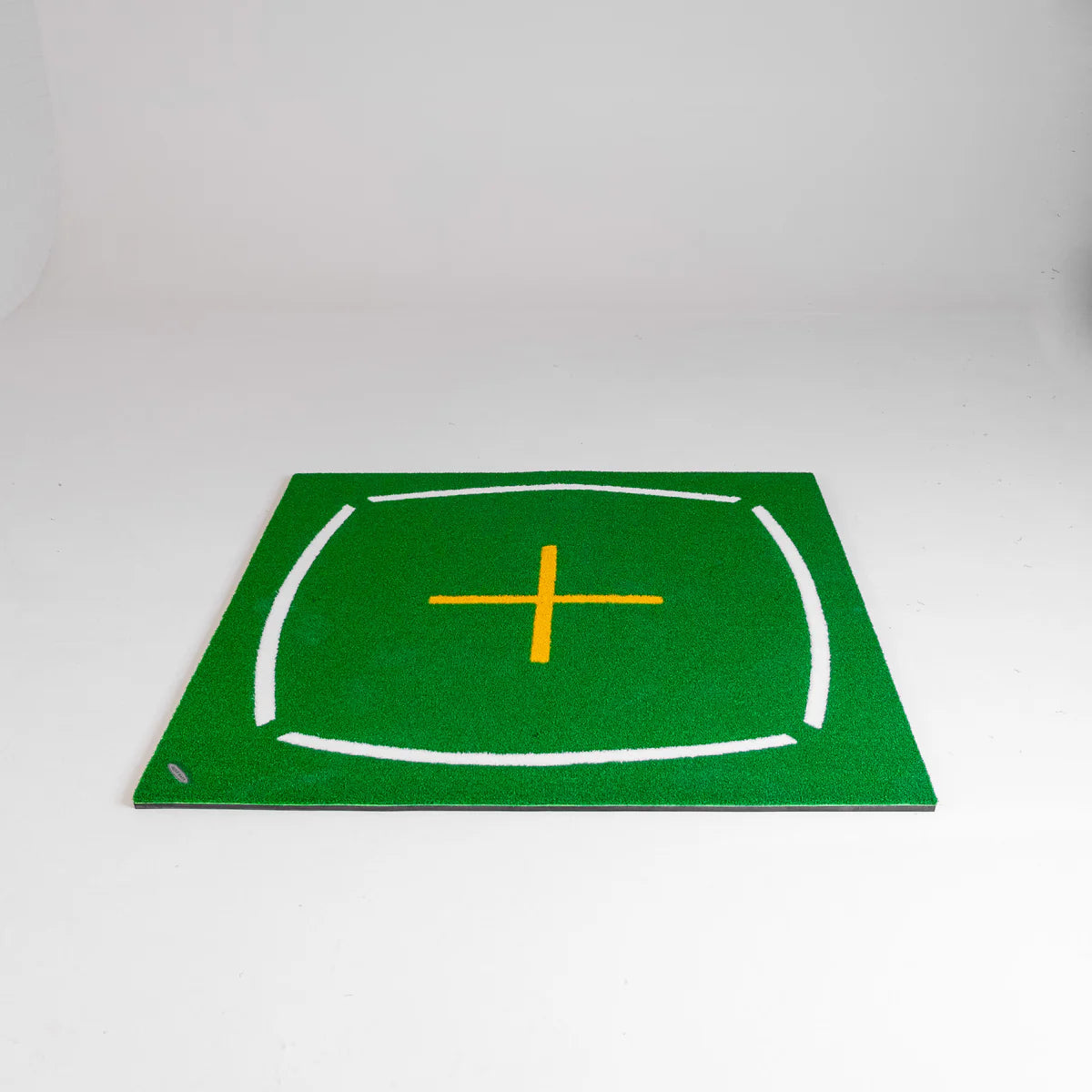
Hit the right dimensions before you invest. The Golf Bays Academy Teaching Hitting Mat measures 4'11" x 4'11". The Impact Sports 4' x 4' Standard Hitting Mat is another option for tighter spaces.
You can build real swing skill without a ball or a club, and these drills work in a living room, hallway or bedroom at no cost. The key is to run them as a progression rather than a random collection: start with the connection drill, move to the posture hold, then the weight-shift drill, and finish with the shadow swing.
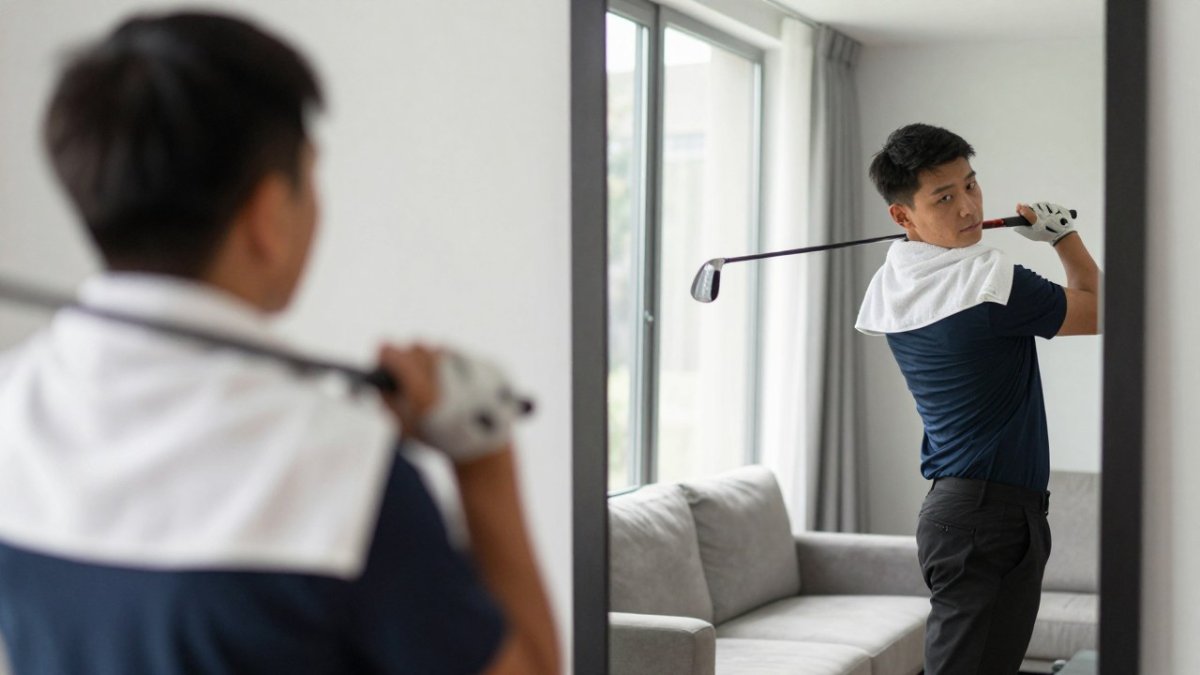
Stage 1, Towel connection drill (2 minutes). Tuck a folded bath towel under both armpits, hold it in place, and make slow backswings and through-swings without letting it drop. This keeps your arms connected to your torso, which controls the swing arc. Pass test: complete 10 slow swings in a row without the towel falling.
Stage 2, Mirror posture hold (30 seconds, 3 rounds). Bend from the hips with a flat back, let your arms hang naturally, and bend your knees slightly. Hold in front of a mirror and check that your spine angle stays constant. Pass test: hold 30 seconds without your chin lifting or your lower back arching. Watch out: beginners often squat by bending the knees too much instead of hinging at the hips, if your thighs burn, you are squatting, not setting up.
Stage 3, Single-leg weight-shift drill (10 seconds per side, 5 rounds). Stand on one foot and swing gently, then switch feet. Balanced finishes depend on a stable base, and this exposes sway faster than a mirror check. Pass test: stay on one foot for 10 seconds through a half-speed swing without hopping or touching down. If you cannot, slow the swing to quarter speed and widen your stance slightly.
Stage 4, Shadow swing with pauses (2 to 3 minutes). Hold your hands together as if gripping a club and swing slowly through the full motion, pausing at the top and at impact. Focus on smooth tempo, not speed. Pass test: complete 10 swings where the pause at the top is steady and the downswing is slower than the backswing. Most beginners rush the transition; if the club feels like it is snatching, count "one-two-three" on the way back and "one" on the way down.
Run this sequence as a 10-minute warm-up before any ball-striking session, or as a standalone practice on days you cannot hit balls. Track how many stages you pass each week, when you can clear all four in one session, you are ready to add a club and a ball to the same motions.
Alignment and posture decide much of where your ball starts, so they deserve steady practice. A simple drill using an alignment stick on the floor shows whether your feet, knees, hips and shoulders point at the target line. Place one stick along the target line and another parallel to it at your toes.
Posture drills build the athletic stance that supports a repeatable swing. Bend from the hips with a flat back, let your arms hang naturally, and bend your knees slightly. Hold this position in front of a mirror for 30 seconds, checking that your spine angle stays constant.
A wall drill helps with sway. Stand with your back heel about two inches from a wall, then make slow backswings. If your hips move toward the wall on the backswing, you are swaying. Once you can keep your hips steady through the backswing, carry that controlled weight shift into a winter practice routine with Open Tee Golf.
Tempo, impact and chipping are where beginners lose the most strokes, so treat this as a 20-minute block with a measurable target for each drill rather than a list of tips. Run them in order: tempo first, impact second, chipping last.
Tempo, 3-to-1 count (5 minutes). Take three counts on the backswing and one on the downswing. Start with the shadow swing, then move to a half-speed swing with a club. Benchmark: 10 swings in a row where the downswing clearly feels faster than the backswing but you never lose balance. A common pattern is that beginners rush the backswing and then decelerate into the ball, if your finish feels cramped, you are decelerating. Count out loud to force the ratio.
Impact, towel-behind-the-ball drill (5 minutes). Place a folded towel a few inches behind a tee or ball on the mat. Swing so the club strikes the mat first, then the ball, and the towel stays in place on clean contact. Benchmark: 8 of 10 swings leave the towel undisturbed. Watch out: if you hit the towel, you are scooping or dipping early, work on forward shaft lean at impact, with your hands ahead of the clubhead, and keep your weight on your front foot through the strike.
Chipping, start-line control (10 minutes). Set up a practice net or a bucket a short distance away and hit short chips with minimal wrist action, ball near the front of your stance. Benchmark: land 7 of 10 chips within one club-length of your target line. If the ball starts left or right, check that your feet and shoulders are square to the start line before changing anything in your swing.
Log three numbers after each session: tempo swings that passed, towel swings that passed, and chips on line out of 10. Repeating the same block weekly gives you a simple progress curve, and when all three benchmarks are consistently met, increase speed or distance rather than adding new drills.
Each of the three core ball-striking drills has a clear benchmark, so you can tell when you are ready to progress.
| Drill | Time | Benchmark |
|---|---|---|
| Tempo: 3-to-1 count | 5 minutes | 10 swings in a row, no loss of balance |
| Impact: towel-behind-the-ball | 5 minutes | 8 of 10 swings leave towel undisturbed |
| Chipping: start-line control | 10 minutes | 7 of 10 chips within one club-length |
Time
If you want to move past household drills, a few pieces of equipment make a real difference. Before investing, read whether a used golf simulator is worth it for your indoor space. Choose based on your space, your budget and what you want to measure.
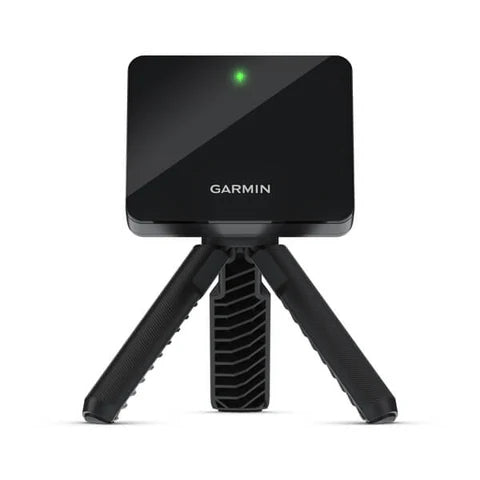
The Garmin Approach R10 Indoor & Outdoor Launch Monitor, priced at $599.00, is a portable option that tracks more than a dozen metrics and records video of each shot. It is designed to move from a home space to the driving range.
For hitting surfaces, the Country Club Elite Hitting Mat ($203.20) is a compact, portable option at 3' x 2' that accepts real wooden tees. If you want a mat that can take replaceable inserts, the Carl's Place Hot Shot Hitting Mat | Foam & Gel Divot Inserts is priced at $610.90 and lets you swap the hitting strip without replacing the whole mat.
Progress is easier to see when you measure it. Once you have launch monitor data, these ways to improve your swing with that data show you what to change. Record the same drill each week, note how many balls you strike cleanly, and track the number of practice sessions you complete.
The Garmin Approach R10 records video clips with real stats overlaid on each shot, which lets you see whether a fix changed your swing or only your feeling about it. You can review your swing clips to compare shots side by side. Pairing a launch monitor with a camera setup like the Carl's Place Golf Swing Camera Set ($595.79) adds a second angle for swing-path analysis.
Common beginner mistakes include gripping too tightly, swaying on the backswing, and rushing the downswing. When a shot goes wrong, check your setup first, then your tempo, then your impact position. A small change in one area often fixes several problems at once.
A good indoor setup starts with the right mat, measured space and a clear practice plan. Explore the hitting mats and launch monitors on our site, or compare setups to find the one that matches the space you have. Start small with a mat and a simple drill plan, then add a launch monitor or camera once your routine is consistent.
Start with three drills that need almost no space: the mirror drill for checking your setup, the towel drill for keeping your arms connected to your body, and the slow-motion swing for building tempo. Each takes about 10 minutes and can be done in a hallway or spare room. Once those feel repeatable, add a putting mat drill or a chipping net to work on short game. Indoor golf practice works best when each drill targets one specific fault rather than trying to fix everything in one session.
Beginners can practice their golf swing indoors by focusing on the basic positions: grip, setup, backswing, and impact. A mirror or phone camera helps you check whether your posture and alignment match what you intend. Use an alignment stick on the floor to confirm your feet, hips, and shoulders are parallel to your target line. Slow, deliberate swings of three to five seconds build the muscle memory you need before adding speed. Practicing for 20 to 30 minutes, three times a week, produces steadier results than one long weekly session.
No. Many useful drills need only a mirror, a towel, a broomstick, or an alignment stick. If you want to work on ball striking, a hitting mat and a launch monitor are the most useful upgrades. The Country Club Elite Hitting Mat ($203.20) accepts real wooden tees, which lets you practice contact in a controlled space. A Garmin Approach R10 launch monitor ($599.00) records club speed, ball speed, and launch angle so you can measure whether your changes are working.
The most useful consistency drills focus on repeating the same setup and swing path every time. The alignment stick drill confirms your stance and target line, while the tempo drill keeps your swing length and rhythm steady. Recording video with a camera setup such as the Carl's Place Golf Swing Camera Set ($595.79) lets you compare swings side by side and spot where your pattern drifts. Consistency improves when you practice the same drill for several weeks rather than switching every session.
