
Customer Svc: 855-620-2330 -
M-Sat -9am-6pm
Speak To Customer Service - 855-620-2330 - M-Sat 9:00am - 6:00pm MST
Customer Svc: 855-620-2330 -
M-Sat -9am-6pm
Speak To Customer Service - 855-620-2330 - M-Sat 9:00am - 6:00pm MST

Last Updated: August 26, 2026
Planning a turnkey home golf simulator installation cost breakdown is the first thing serious buyers get wrong. They budget for the hardware, forget everything else, and end up surprised by electrical work, software subscriptions, and calibration fees that can add thousands to the final number. At Total Golf Simulators, we work with golfers at every budget level, and the single most common mistake is treating the enclosure and launch monitor price as the total cost. Below, we break down every tier, every hidden line item, and every decision point so you can plan your build with real numbers.

A turnkey home golf simulator is a complete, ready-to-use indoor golf setup that includes all hardware, software, and installation in a single package. The total cost of ownership spans a wide range depending on component quality, room size, and whether you hire professional installers.
| Tier | Typical Total Cost | Launch Monitor Quality | Installation | Best For |
|---|---|---|---|---|
| Entry-Level | $3,000-$8,000 | Camera-based, limited data points | DIY | Casual practice, tight budgets |
| Mid-Tier | $8,000-$20,000 | Radar or dual-tech, full ball data | DIY or pro | Serious amateurs, instructors |
| Premium | $20,000+ | Tour-grade, full spin rate & club head speed | Professional | Dedicated rooms, commercial use |
Entry-level packages offer the most accessible path into home simulation with real trade-offs. The launch monitor captures basic ball data: ball speed, carry distance, and limited data points. Spin rate accuracy and club head speed precision are compromised compared to higher-end systems. The enclosure is usually a DIY frame with a standard impact screen and basic netting. Assembly takes four to six hours for a first-time build. What works: it gets a ball in the air and a course on screen for a fraction of mid-tier pricing. What doesn't: ball flight realism and swing analysis depth are noticeably limited.
This is where the experience shifts from "video game feel" to genuine training tool. Mid-tier systems typically include a dual-technology or photometric launch monitor that captures full ball data: spin rate, launch angle, ball speed, and club head speed with meaningful accuracy. The impact screen quality improves significantly, and enclosure construction uses heavier frame materials with proper foam padding. Software subscriptions unlock more courses, better graphics, and deeper swing analysis overlays. Many buyers opt for a short-throw projector with higher resolution. Professional installation typically runs $500-$3,000 depending on room complexity.
Premium builds use radar-based or multi-camera technology that captures every meaningful data point: spin axis, smash factor, attack angle, and dynamic loft. The enclosure is typically a custom build or modular panel wall system with professional-grade impact screen material and welded steel or machined aluminum frame construction. Projectors are 4K-capable with short-throw ratios optimized for the room. Turnkey installation includes electrical work, cabling, calibration, and often a dedicated gaming PC configured for the simulation software.
A turnkey golf simulator package includes every component needed to hit a ball and see it fly on a virtual course without sourcing parts separately. The core hardware components and software layer work together as a system, and compatibility between them is what separates a well-specced build from an expensive frustration.
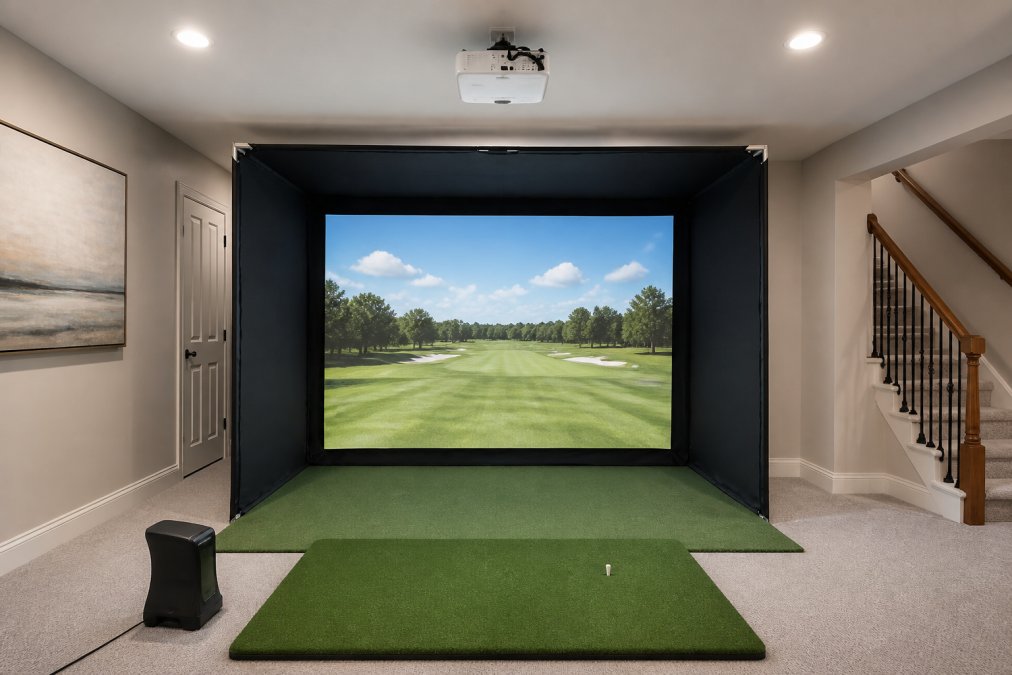
Every functional simulator requires six core components:
Mounting hardware, cabling, and subfloor protection are supporting components that many buyers overlook until installation day.
Software is where the ongoing cost lives. Most simulation platforms operate on annual subscription models rather than one-time purchases. Common platforms charge annual fees for course libraries, online play features, and swing analysis tools. According to Golf Simulator Forum's annual software comparison, subscription costs across major platforms range from under $200 to over $600 per year depending on feature tier, a meaningful number when projected over five years of ownership.
Golf simulator room requirements are more specific than most buyers expect. The minimum usable space is roughly 10 feet wide, 10 feet tall, and 15 feet deep, though those are floor minimums for shorter players. A 10-foot ceiling is workable; 9-10 feet is ideal. Taller players or those with a high backswing arc need more vertical clearance.
Room width matters for side netting and safety. A 12-15 foot width is preferred for centered hitting with clearance on both sides. Depth affects projector throw distance and the relationship between the hitting position and the screen. Most short-throw projectors require 8-12 feet from the screen to produce a full image at the correct aspect ratio. Lighting control affects image quality; enclosures with blackout fabric on side panels and ceilings produce noticeably sharper visuals than open-bay setups.
Professional golf simulator installation services cost more upfront and save more in hidden time and error costs than most buyers calculate. DIY assembly for a standard enclosure takes four to eight hours for a first-time builder. Where DIY breaks down is calibration. A launch monitor that is not correctly positioned, leveled, and configured to the software will produce inaccurate ball data. Professional installers handle on-site calibration as part of their service.
| Factor | DIY | Professional Installation |
|---|---|---|
| Upfront labor cost | $0 | $500-$3,000+ |
| Assembly time | 4-8+ hours | 2-4 hours |
| Calibration accuracy | Variable | Consistent |
| Electrical/HVAC work | Separate contractor | Often coordinated |
| Error risk | Higher | Lower |
| Best for | Budget builds, tech-comfortable buyers | Premium builds, instruction use |
The hardware price is the starting point, not the finish line. A complete turnkey home golf simulator installation cost includes several line items that appear after the initial purchase decision.
Dedicated electrical circuits are a real requirement for many simulator setups. A gaming PC, short-throw projector, launch monitor, and lighting running simultaneously can draw significant power (nfpa.org). An electrician's visit to add a dedicated 20-amp circuit typically costs several hundred dollars and is rarely included in a simulator package price. HVAC is the hidden cost that surprises commercial buyers most. A basement or garage simulator room that is comfortable in winter may become unusable in summer without supplemental cooling. Structural upgrades include subfloor protection, ceiling reinforcement for ceiling-mounted projectors, and wall protection behind the enclosure.
Depending on the scope of electrical work and any structural modifications, a building permit may be required under local residential codes. According to the National Electrical Code standards maintained by NFPA, new circuit additions in residential buildings typically require a permit and inspection. Unpermitted electrical work can create complications during a home sale.
Homeowner's insurance is worth a call before installation. A simulator setup that includes a large screen, gaming PC, and launch monitor represents a significant asset. Some policies require a rider to cover electronics and specialty equipment at replacement value. A professionally installed, dedicated simulator room is increasingly valued as a premium feature in real estate listings. Get the permits, document the installation, and the simulator becomes an asset rather than a liability.
The best golf simulator packages for home balance enclosure quality, screen performance, and compatibility with your chosen launch monitor.
Budget-Friendly Entry Point: The Golf Bays EasySim DIY Enclosure at $999 is the most accessible enclosure on the market. Its 4:3 aspect ratio simplifies projector selection, and the compact 1-meter depth works in tighter spaces.

Mid-Range DIY with Complete Hardware: The Carl's Place DIY Golf Simulator Enclosure Kit at $1,149.95 includes a premium impact screen with full floor-to-ceiling coverage and heavy-duty black nylon side panels. Multiple size options accommodate rooms from compact 8.5-foot setups to 12-foot-plus bays. Assembly takes one to two hours with two people.
Step-Up Performance: The Golf Bays SimBox Enclosure at $1,615 includes the PRO+ premium impact screen as standard, rated for heavy home and commercial use with HD/4K image quality. The click-tube aluminum frame assembles in approximately 45 minutes without tools.
Professional-Grade Home Build: The Carl's Place Pro Golf Simulator Enclosure (2025 Model) at $3,409.95 is the enclosure for buyers who want a permanent, high-performance setup. BlackStop fabric improves projector image brightness and color depth. The adjustable crossbar system accommodates different launch monitor positions without modification.
Turnkey Booth Solutions: The SimBooth 1 at $7,495 and SimBooth 2 at $8,495 are purpose-built enclosures that include turf and flooring. The aluminum structure carries a 5-year manufacturer warranty.
Multi-Purpose Space Solution: The Remote Control Motorized Drop Down Enclosure at $2,650 solves the dedicated-space problem. The ceiling-mounted system retracts when not in use, preserving the room for other purposes.
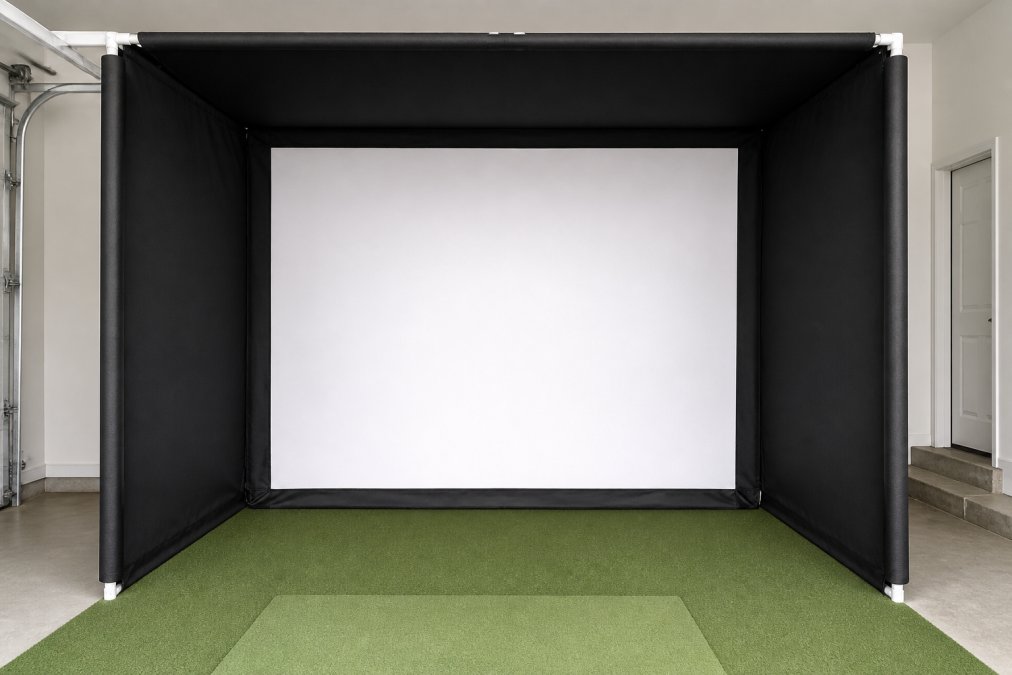
Choosing the right turnkey home golf simulator comes down to three variables in this order: room dimensions, primary use case, and budget.
Start with room dimensions. Measure ceiling height, width, and depth before looking at any product. A 10-foot ceiling is workable for most players. Below 9 feet, options narrow significantly and driver swings become a real concern.
Primary use case determines launch monitor specification. Casual practice and entertainment use does not require tour-grade accuracy. Instruction use does. If students are making swing decisions based on ball data, the launch monitor needs to capture spin rate, attack angle, and club head speed with high fidelity.
A common mistake is optimizing for the enclosure and underspeccing the launch monitor. The enclosure is visible; the launch monitor determines whether the system actually works for its intended purpose. Allocate budget to the launch monitor first, then fit the enclosure and projector to what remains.
For buyers converting a garage or spare room, the DIY Golf Enclosure System from All Sport Systems at $1,349 offers five size options and compatibility with most launch monitors. For buyers who want a permanent, premium room from day one, the modular panel wall system at $6,850 with optional professional assembly creates a dedicated simulator studio that holds its value. The golf simulator market has matured enough that there is a credible option at every price point. The question is not whether a home simulator is possible, it is which system fits your space, your game, and your honest total budget.

Building a home simulator involves more decisions than most buyers anticipate, and the gap between a satisfying setup and an expensive regret usually comes down to planning. Total Golf Simulators offers a curated selection of enclosures, launch monitors, hitting mats, and projectors, with expert guidance to help you match components to your specific room and goals. Use the Price Match Guarantee and free shipping on most items to build your setup with confidence. Shop Golf Simulators at Total Golf Simulators and get the right system the first time.
A: Professional turnkey installation adds $1,500-$5,000 or more on top of hardware costs, depending on room complexity and what the installer handles. Total project costs for a professionally installed mid-tier setup typically run $12,000-$25,000 once you factor in the enclosure, launch monitor, projector, hitting mat, software, and labor.
A: Most golfers need a minimum ceiling height of 9 feet to swing comfortably without risk of striking the ceiling on a full driver swing. Taller players or those with an upright swing plane should target 10 feet or more. A 10-foot ceiling is the widely recommended standard for a dedicated home simulator room. Some compact enclosures, like the Carl's Place DIY kit, specify a minimum of 8.5 feet, but that leaves very little clearance for most adult golfers.
A: Yes, several costs catch buyers off guard. Electrical upgrades for a dedicated 20-amp circuit, HVAC adjustments to manage heat from projectors and gaming PCs, subfloor leveling, and mounting hardware all add to the total. Software subscriptions for platforms like E6 Connect or GSPro run $150-$500 per year. If the installation requires a building permit, expect additional fees. Foam padding, safety netting, and cabling are often sold separately from base enclosure kits.
A: A DIY kit ships the enclosure, impact screen, and frame hardware to your door and requires you to assemble, calibrate, and integrate every component yourself. Assembly typically takes 2-6 hours for a two-person team. A turnkey installation means a professional team handles on-site assembly, projector calibration, launch monitor alignment, software setup, and testing. Turnkey setups cost more upfront but reduce setup errors and deliver a ready-to-use system from day one.
A: A permanent, high-quality golf simulator installation can add appeal and perceived value in the luxury home market, particularly for golf-focused buyers. However, resale value depends heavily on how the room is finished, whether the equipment is transferable, and local buyer demand. A professionally built simulator room with proper electrical work and clean aesthetics is more likely to contribute to home value than a freestanding DIY enclosure. Portable or motorized drop-down systems preserve room flexibility without permanent structural changes.
This article was written using GrandRanker